Before any spend: count calls and quote requests
Google's bidding aims at the results you count. A counted result is called a conversion. For a tree service it is a phone call or a quote form. If nothing is counted, Google simply buys low-cost clicks, and for tree words those are DIY searches.
- In Google Ads, open Goals, then Conversions, and create a conversion action.
- Add calls from ads and calls from your website, each with a minimum call length so misdials are ignored.
- Add your quote form, counted on submit.
- Mark those primary so bidding uses them. Mark anything else secondary.
- Call from an ad and send the form yourself. Both should show up within a day.
Next, keep a lead list. For each lead note the job, whether you could quote it, whether you won it, and the value. A crane removal and a single stump both look like one lead to Google. With steady volume you can upload the quoted and won leads, and Google will bid toward the kinds of calls that turn into paid tree work.
Settings that keep tree service ads in your area
Three settings, done once.
- Search only. Open Networks in campaign settings. Untick Search Partners and the Display Network. Your ad should show when someone types "tree removal near me" into Google and nowhere else.
- People in your area. In Locations, add the cities or zip codes your truck and chipper can reach in a sensible drive. In Location options, choose "Presence: people in or regularly in your included locations". The default also reaches people only interested in your area.
- Auto-apply off. In Recommendations, open Auto-apply and untick every box. Otherwise Google can add keywords like "tree trimming tools" for you.
Set the ad schedule to hours when someone can answer. If the whole crew is up a tree all day, send calls to a person who can pick up, or lean on the quote form and call back at breaks.
How to structure a tree service campaign
An ad group is a set of keywords that share the same ads. Give each service one ad group and one landing page.
| Ad group | Example searches | Landing page |
|---|---|---|
| Tree removal | tree removal near me, tree removal service | Your removal page |
| Pruning and trimming | tree trimming service, tree pruning near me | Your pruning page |
| Stump grinding | stump grinding near me, stump removal service | Your stump page |
| Storm clean-up | emergency tree removal, fallen tree removal | Your storm page |
| Arborist reports | arborist near me, tree inspection | Your arborist page |
The common mistake is one ad group for everything, sent to the home page. Someone with a stump sees an ad about pruning and a page about removals.
If you can, put removals in their own campaign with their own budget. A removal is the big quote, and you don't want a run of stump clicks using up the day's money first. Skip any service you don't offer, such as reports, planting or land clearing.
Keywords people type when a tree has to go
A keyword is your phrase. A search term is what the person typed. Ready-to-hire tree searches name a service:
- tree removal near me
- tree service near me
- tree trimming service
- stump grinding near me
- emergency tree removal
- arborist near me
Add your city or county to a few. Keep each ad group to a short list about its one service.
Match types, simply:
- Exact match: your ad shows for that search or one meaning the same.
- Phrase match: your ad shows when the search contains your phrase's meaning plus other words.
- Broad match: your ad shows for whatever Google links to it. For "tree" that covers nurseries, Christmas trees and family trees. Leave it off.
Start with phrase and exact match. Each week, pick out the search terms that became paid jobs and add them as exact match keywords to the right ad group.
Tree searches to block from day one
A negative keyword tells Google not to show your ad. The word "tree" is typed for a hundred reasons. Add these at the account level before launch:
- DIY: how to, diy, kill, killer, poison, video.
- Tool shoppers: chainsaw, for sale, rental, pole saw, grinder rental.
- Job seekers: jobs, hiring, salary, careers, climber jobs.
- Students: course, training, certification, school.
- Offcut hunters: firewood, mulch, wood chips, logs. Skip this group if you sell them.
- Other trees: christmas, family, nursery, seedlings, tree house, fruit trees for sale.
- Other companies' names.
Add each as a phrase match negative trimmed to the core word. "Rental" blocks "stump grinder rental near me" and all its cousins. Block work you don't do, such as "planting" or "land clearing".
Then the search-term check. Every day or two for the first two weeks, then weekly:
- Open the search terms report under Insights and reports.
- Sort by cost, highest first.
- Ask: would I send someone to quote that?
- If not, block the core word.
Writing ads for removal, pruning and stumps
A responsive search ad holds up to 15 headlines and 4 descriptions that Google mixes. Fill in plenty.
- The job: "Tree Removal", "Stump Grinding From One Stump Up".
- The place: your city or "Near You".
- Why you: insured, certified arborist on staff if true, full clean-up, own equipment.
- The next step: "Call for a free quote" if your quotes are free.
Insurance is worth a headline in this trade. A homeowner with a tree over the house wants to know they are covered if something goes wrong.
One ad per ad group. A storm ad should talk about speed. A pruning ad can talk about the health and shape of the tree.
Add the extras, called assets:
- Call asset: your number on the ad, tappable on a phone.
- Sitelinks: at least four, such as "Tree Removal", "Stump Grinding", "Get a Quote" and "Reviews".
- Callouts: short phrases like "Fully Insured" or "Clean-Up Included".
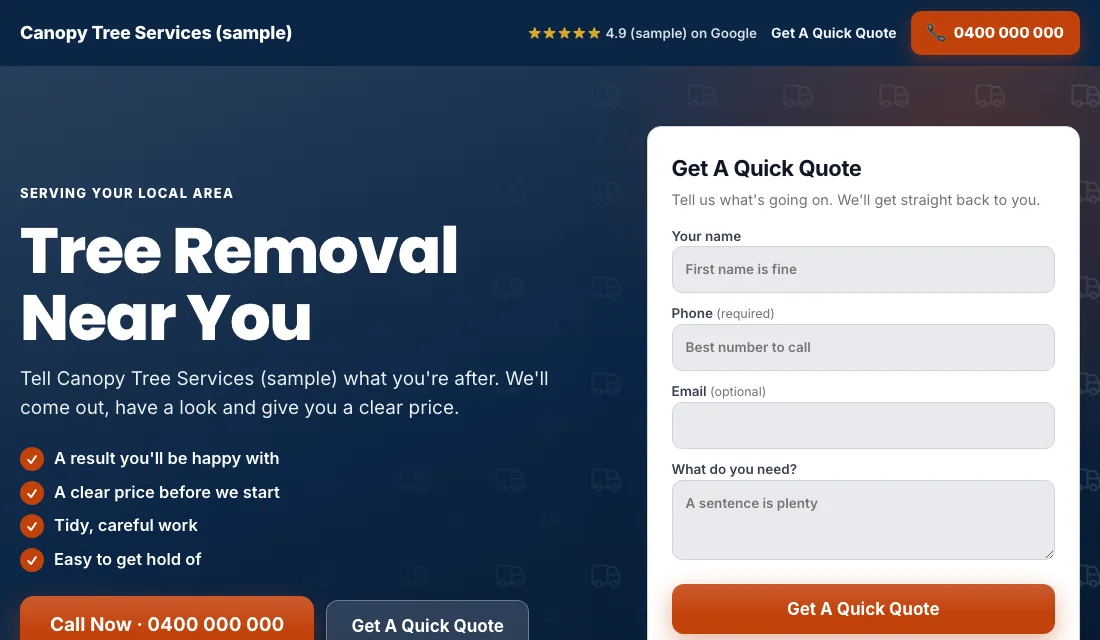
The landing page for each tree job
One page per ad group. Check each one:
- The headline matches the search. A stump grinding ad lands on a stump grinding page.
- Phone number at the top, tap to call.
- A short quote form visible without scrolling: name, phone, address, and what the tree problem is. Photo upload helps if your form has it.
- Before and after photos of your own jobs, and your crew and equipment at work.
- Reviews near the top.
- A line on insurance. If permits are needed where you work, say whether you help with them.
- No menu, no links away.
- Fast on a phone.
Google scores how closely keyword, ad and page match. A good score means paying less for the same position.
Budget and bidding for tree work
Multiply the leads you need each month by what you can afford for one. That is your starting budget. Fund it for two months or more.
- Maximize Conversions from the start. With tracking working, Google bids toward calls and forms. Give it two to three weeks.
- If a new account barely spends. Switch to Maximize Clicks with a cap on the bid per click, then return to Maximize Conversions once leads arrive.
- A target cost per lead. After about 30 conversions in 30 days, you can set Target CPA, a target cost per lead. Set it 15 to 20 percent above your recent real cost. Too tight and Google stops spending. Lower it gradually each month while leads keep coming.
No manual bidding. And don't make changes based on a storm week or one dead week. Neither is normal.
How to run Google Ads for tree services through the year: weekly and monthly checks
Weekly:
- Review search terms and block the junk.
- Add searches that became jobs as exact match keywords.
- Update your lead list: quoted, won or junk, with the job type.
- Return missed calls the same day. Tree quotes go to whoever turns up first.
Monthly:
- Cost per lead and cost per won job, by ad group.
- Pause an ad group that spends and never wins.
- Test a call and a form.
- Add fresh job photos to the pages.
- Check the split of budget between removals and smaller jobs.
Seasons and timing for tree services
- Storm season: a single night of wind can fill a week. Build the storm clean-up ad group in advance and keep it ready. Raise its budget when the forecast turns.
- Late fall and winter: in many places this is pruning time, while trees are dormant. It is also when owners remove dead trees before winter weather. Push pruning and removal.
- Spring: growth shows which trees are dead or crowding the house. Removal and trimming searches rise.
- Summer: steady trimming work, and stump grinding as people work on their yards.
Between storms, the work is the slower quote: the big tree over the roof, the roots in the sewer line. Keep a steady budget running for those all year.
Or let software handle it
You have now seen how to run Google Ads for tree services yourself: count every lead, fix the settings, keep removal, pruning, stumps and storm work apart, block the DIY and chainsaw searches weekly, and step your bidding up as leads build. It pays if you keep doing it.
If you would sooner be on the job, Local Service Ads AI does these checks every day and waits for your OK before anything changes, unless you tell it to go ahead. See Google Ads for tree services.