Start with call tracking, because towing leads are calls
A conversion is the result you want from an ad click. For most trades it is a call or a form. For a tow operator it is nearly always a call. If Google can't see calls, it has nothing to aim at.
- In Google Ads, open Goals, then Conversions, and create a conversion action.
- Add calls from ads. This counts taps on the number shown on the ad itself.
- Add calls from your website, so calls from your landing page are counted too.
- Give both a minimum call length. A real tow call takes long enough to get a location and a vehicle. A hang-up doesn't.
- If you take trade or long-distance bookings by form, add that form as well.
- Mark these as primary, which means bidding uses them. Mark everything else secondary.
- Tap your own ad's number from a phone and check the call shows in Google Ads within a day.
Keep a simple dispatch log alongside it: time of call, type of tow, whether a truck went, and what it paid. A call asking the price and hanging up, and an accident tow with storage, are both "one call" to Google. Later you can upload the calls that became paid jobs, so bidding favors those.
Account settings a tow operator must change
- Search only. In campaign settings under Networks, untick Search Partners and the Display Network. Nobody stuck on a highway is reading a banner.
- People physically in your area. In Locations, add the cities or zip codes your trucks reach quickly. In Location options, choose "Presence: people in or regularly in your included locations". This matters more for towing than for almost any trade. The default setting shows your ad to people searching about your area from somewhere else, and they can't be towed by you.
- Auto-apply off. Under Recommendations, open Auto-apply and untick everything, so Google can't add keywords such as "towing capacity" behind your back.
Then set the ad schedule honestly. If you cover nights, run all hours. If the phone goes to voicemail after 10 p.m., stop the ads at 10 p.m.
Ad groups for breakdowns, accidents and trade tows
An ad group is a set of keywords that share ads. Use one per type of job, each with its own landing page.
| Ad group | Example searches | Landing page |
|---|---|---|
| Breakdown towing | tow truck near me, towing service near me | Your breakdown page |
| Accident towing | accident towing, wrecker service near me | Your accident page |
| Roadside help | jump start service, flat tire help, lockout service | Your roadside page |
| Trade and dealer tows | car transport for dealers, tow to repair shop | Your trade page |
| Long-distance towing | long distance towing, vehicle transport quote | Your long-distance page |
Breakdown and accident work is urgent and comes at any hour. Trade tows for dealers, auctions and repair shops are booked in the daytime. Put the daytime work in its own campaign so you can give it business hours and a separate budget.
Only build what you offer. If you don't do roadside jump starts, heavy trucks or motorcycles, leave them out.
Keywords a stranded driver types
A keyword is the phrase you ask Google to match. A search term is what the driver typed. Stranded drivers type short, urgent phrases:
- tow truck near me
- towing near me
- 24 hour towing
- emergency tow truck
- roadside assistance near me
- flatbed tow truck near me
Add a few with your city or the main highways you cover.
Match types decide how loose the match is:
- Exact match shows your ad for that search or one with the same meaning.
- Phrase match shows it when the search includes your phrase's meaning with extra words.
- Broad match shows it for anything Google thinks is related, which for "towing" includes hitches, trailers and truck sales. Leave it off.
Start on phrase and exact. Each week, see which search terms led to paid tows and add them as exact match keywords. Night after night, the same handful of searches bring most of the work.
Searches to block from day one for a towing company
A negative keyword is a search you won't pay for. The word "tow" attracts a lot of people with no car trouble. Add these at the account level:
- Truck buyers: for sale, used, dealer, auction, financing.
- Job seekers: jobs, driver jobs, hiring, salary, careers, training, cdl.
- People towing something themselves: capacity, hitch, trailer, dolly, rental, strap, tow bar, how to.
- Toys and games: toy, game, lego, simulator.
- Insurance and clubs: membership, insurance, coverage. These people want their plan's number, not yours.
- Other companies' names.
Add each as a phrase match negative cut to its core word. "Capacity" blocks every pickup owner checking what they can pull. If you don't run an impound lot, add "impound" too. Be careful with "cheap" and "cost". A driver asking the price is still a driver who needs a tow.
Check search terms daily for the first two weeks, then weekly:
- Open the search terms report under Insights and reports.
- Sort by cost.
- For each search, ask: is that someone who needs a truck now, in my area?
- If not, block the core word.
Writing towing ads that get the tap
A responsive search ad holds up to 15 headlines and 4 descriptions. Google mixes them. A stranded driver reads for two seconds, so be plain.
- The job: "Tow Truck Near You", "Accident Towing".
- The hours: "Open 24 Hours" if it is true, or your real hours.
- The area: your city, or the highways you cover.
- Why you: fast arrival, flatbed available, licensed and insured. Don't promise an arrival time you can't keep.
- The next step: "Call now. A dispatcher answers."
The most important extra is the call asset. It puts your number on the ad so the driver can call without visiting a page. Add it first and check the number is right.
Then add:
- Sitelinks: four or more, such as "Breakdown Towing", "Accident Towing", "Roadside Help" and "Service Area".
- Callouts: short phrases like "Flatbed Trucks" or "Cards Accepted".
Write a separate ad for trade tows that speaks to shops and dealers, with business hours.
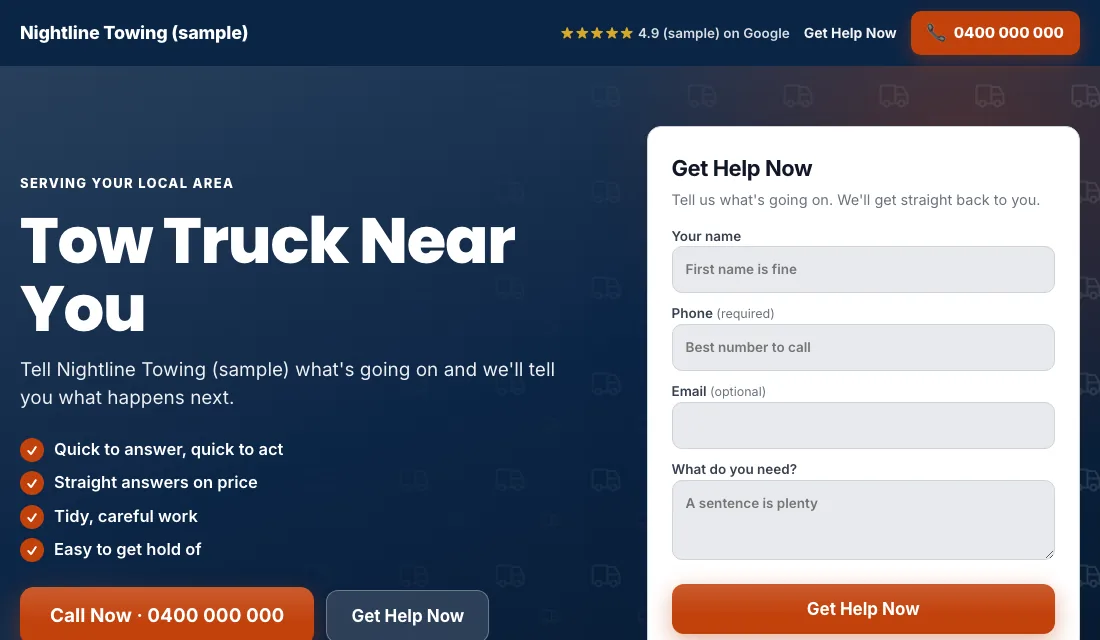
A landing page built around the phone number
Many drivers will call straight from the ad. For those who click, the page has one job.
- A large phone number at the very top that starts a call when tapped. Repeat it down the page.
- A headline matching the search: "24 Hour Towing in" your city.
- The area you cover, in a line or two, so the driver knows you can reach them.
- What you tow: cars, pickups, motorcycles, whatever is true.
- Photos of your real trucks with your name on the door.
- A few reviews.
- No menu and nothing to read through.
- It must load fast on weak signal. Keep the page light.
For trade and long-distance pages, add a short form: name, phone, pickup, drop-off and vehicle.
Google scores how well keyword, ad and page match. A higher score means a lower cost for the same spot, and towing clicks are worth protecting.
Budget and bidding for a towing account
Work out the budget from your numbers: extra tows wanted each month, and what you can pay for a call that becomes one. Fund it for two months.
- Maximize Conversions from the start. Once calls are counted, let Google bid toward them. Give it two to three weeks.
- If a brand-new account won't spend. Switch to Maximize Clicks with a cap on the bid per click until calls come in, then go back to Maximize Conversions.
- Target cost per lead. After about 30 conversions in 30 days, you can set Target CPA, a target cost per call. Set it 15 to 20 percent above what a call has been costing. Too low and Google stops showing you. Lower it bit by bit each month while calls hold.
Don't bid manually. Don't judge on one quiet weekend either.
How to run Google Ads for towing companies: weekly and monthly checks
Weekly:
- Check search terms and block truck buyers, job seekers and hitch shoppers.
- Add searches that became paid tows as exact match keywords.
- Match the dispatch log to the calls: job, no job or junk.
- Check missed calls by hour. If calls are missed at night, fix the phone cover or trim the schedule.
Monthly:
- Cost per call and cost per paid tow, by ad group.
- Pause an ad group that spends and never pays.
- Tap your own ad and page numbers to test tracking.
- Review the service area. Tighten it if far-off calls waste truck time.
Seasons and timing for tow work
- Cold snaps: dead batteries, cars that won't start and slide-offs. Calls climb on the first freezing morning.
- Summer heat: overheated engines and blown tires on long drives.
- Holiday weekends: heavy travel means more breakdowns and accidents, often far from the driver's home.
- Storms and heavy rain: accident tows and flooded cars.
- Nights and weekends, all year: repair shops are closed and fewer competitors answer. If you cover those hours, they can be the hours that pay you most.
Raise the budget ahead of a cold snap or a holiday weekend, and bring it back afterward.
Or have software watch it day and night
That is how to run Google Ads for towing companies by hand: count calls, show only to people inside your area, split urgent tows from trade work, block the buyers and job seekers, and keep your phone number a single tap away at the hours you cover. It needs a look every week.
Local Service Ads AI does these checks every morning and waits for your OK before changing anything, unless you tell it to go ahead. See Google Ads for towing companies.