Count every solar lead from the first click
A conversion is the result you want from a click. For a solar installer it is a quote request form or a phone call. Google's bidding goes after whatever you count. Count nothing, or count page views, and it buys visitors who were only curious about solar.
- In Google Ads, open Goals, then Conversions, and add a conversion action.
- Add your quote form, counted when it is sent.
- Add calls from ads and calls from your website, with a minimum call length so short misdials are left out.
- Mark those as primary, meaning bidding uses them. Mark calculator views, brochure downloads and the like as secondary.
- Send a test form and make a test call. Both should show in Google Ads within a day.
Because a homeowner may take weeks to decide, a lead list matters more here than in almost any trade. For each lead record whether they own the home, whether you could quote, whether they signed, and the system value. When you have steady numbers, upload the quoted and signed leads to Google Ads. Then bidding learns what a real solar buyer looks like, not just who fills in forms.
Lock these settings before any solar ad runs
- Search only. In the campaign's Networks setting, untick Search Partners and the Display Network. You want people typing "solar panel installers near me" into Google, not banner views on other sites.
- People inside your install area. Under Locations, add the cities or zip codes your crew covers. In Location options pick "Presence: people in or regularly in your included locations". The default also shows ads to people who are only interested in your area, and solar attracts readers from everywhere.
- Auto-apply off. In Recommendations, open Auto-apply and untick everything. Left on, Google may add broad keywords such as "solar energy" that bring researchers, not buyers.
Solar research happens in the evening on the couch. If your form works without anyone answering a phone, you can run ads all hours. If you rely on calls, match the schedule to when someone picks up.
Campaign structure: panels, batteries and inverters apart
An ad group is a set of keywords sharing the same ads. Use one per service, and send each to its own landing page.
| Ad group | Example searches | Landing page |
|---|---|---|
| Solar panel installation | solar panel installers near me, solar company near me | Your panel installation page |
| Home batteries | solar battery installer, home battery installation | Your battery page |
| Inverter replacement | solar inverter replacement, inverter repair | Your inverter page |
| System upgrades | add panels to existing system, solar system upgrade | Your upgrade page |
A first-time buyer wants to know about payback and roof fit. Someone adding a battery already has panels and wants to know what works with them. One ad can't speak to both, and one page can't either.
If budgets allow, put panels and batteries in separate campaigns, since a campaign is where the daily budget lives. Leave out what you don't do. If you don't clean panels, service other installers' systems or do off-grid cabins, don't build for them.
Keywords that signal a homeowner wants a quote
The keyword is what you tell Google. The search term is what was typed. Solar has a wide gap between the two, because so many people search out of interest.
Searches from people ready to get a price name an installer or a job:
- solar panel installers near me
- solar company in your city
- solar installation quote
- solar battery installer
- solar inverter replacement
Avoid research phrases as keywords, such as "how do solar panels work" or "is solar worth it". They cost money and rarely become quotes.
Match types, in plain words:
- Exact match: your ad shows for that search or one with the same meaning.
- Phrase match: your ad shows when the search includes the meaning of your phrase, with words added.
- Broad match: your ad shows for anything Google links to it. Keep it off.
Start with phrase and exact. Every week, look at which search terms led to a quote you could give, and later a signed system. Add those as exact match keywords in the right ad group.
Searches a solar business should block on day one
A negative keyword stops your ad showing for a search. Add these at the account level before launch:
- Job seekers: jobs, salary, hiring, careers.
- Students: course, training, certification, school.
- DIY and kits: diy, kit, how to, wiring diagram.
- Shoppers: for sale, wholesale, used, amazon, ebay.
- Small solar products: lights, charger, generator, fountain, camping, rv.
- Investors and researchers: stocks, shares, calculator, news.
- Giveaway hunters: "free solar panels" as a phrase, not the bare word "free".
Add each as a phrase match negative cut to the core word. "Kit" catches "diy solar kit" and every other version. If you don't do a job, block it too: "cleaning", "off grid", "pool heating".
Then check search terms every day or two for the first two weeks, and weekly after:
- Open the search terms report under Insights and reports.
- Sort by cost.
- For each search ask: is this a homeowner wanting a quote in my area?
- If not, block the core word.
Solar ads that name the job and the area
A responsive search ad gives Google up to 15 headlines and 4 descriptions to mix. Fill most of them.
- The job: "Solar Panel Installation", "Add a Battery to Your Solar".
- The area: your city, or "Local Installers".
- Why you: licensed installers, in-house crew, years in business, written warranty. Say only what is true.
- The next step: "Get a quote for your roof this week."
Don't quote savings figures or incentive amounts in an ad unless you have checked them and can keep them current.
Write a separate ad for each ad group. Then add assets, the extras that enlarge your ad:
- Call asset: your phone number, tappable on a phone.
- Sitelinks: at least four, such as "Get a Quote", "Batteries", "Our Installs" and "Reviews".
- Callouts: short phrases such as "Licensed Installers" or "No Subcontractors".
A quote page for each solar service
One page per ad group. Check each against this list:
- The headline matches the search. A battery search lands on a battery page.
- The phone number is at the top and taps to call.
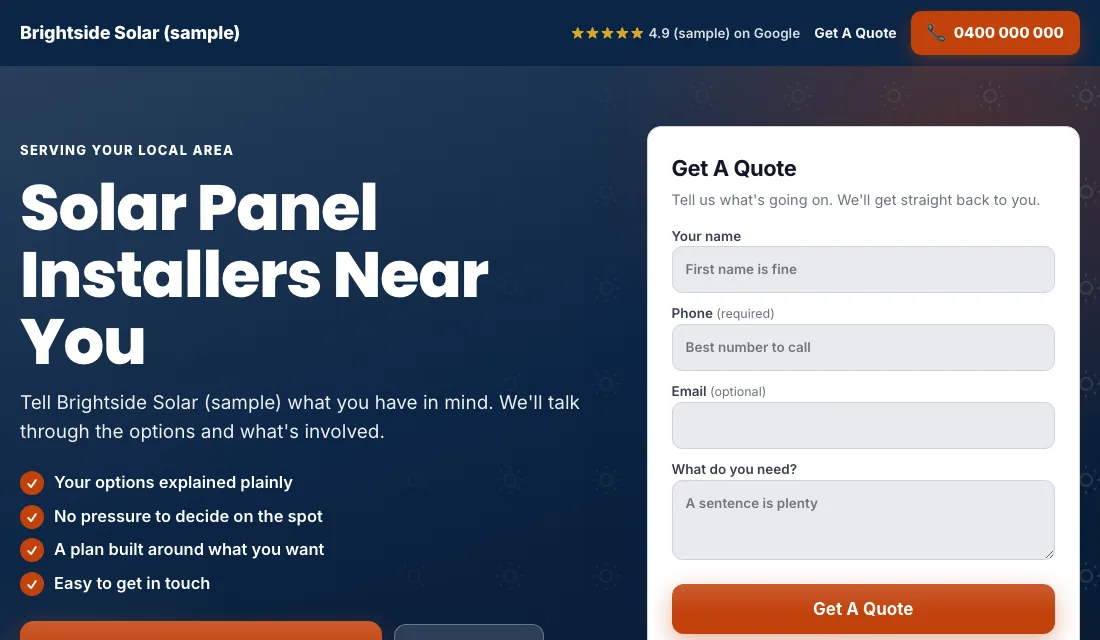
- The quote form is visible without scrolling. Ask for name, phone, address, and whether they own the home. That last question saves you calls to renters.
- Photos of your own installs on local roofs, and your own crew.
- Reviews near the top. People spending this much read them.
- No menu, no blog links, nothing that leads away.
- Fast on a phone.
Google scores the match between keyword, ad and page. A higher score lowers what you pay per click, which adds up in a trade where clicks are not cheap.
Budget and bidding when the sale takes weeks
Set the budget from your own numbers: leads needed per month times what you can afford per lead. Fund it for two to three months. A solar lead from week one may sign in week six, so a short test tells you nothing.
- Begin with Maximize Conversions. Once forms and calls are counted, let Google bid toward them. Leave it for two or three weeks.
- Fallback for a new account that won't spend. Use Maximize Clicks with a cap on each click's bid until leads start, then go back to Maximize Conversions.
- Target cost per lead. At about 30 conversions in 30 days, you can set Target CPA, a target cost per lead. Start 15 to 20 percent above your real cost per lead. A target set too low makes Google stop spending. Tighten it month by month while lead numbers hold.
Never bid manually. And judge on quotes and signed systems from your lead list, not on clicks.
How to run Google Ads for solar installers once the ads are live
Weekly:
- Search terms: block the junk.
- Add searches that became quotes as exact match keywords.
- Update the lead list: owner or renter, quoted, signed, value.
- Call new leads fast. The homeowner has asked two other installers.
Monthly:
- Cost per lead and cost per quoted lead, for each ad group.
- Pause an ad group that has spent well and produced no quotes.
- Test the form and the phone number.
- Check that any incentive wording in your ads and pages is still correct.
- Review budget split between panels and batteries.
Seasons and timing for solar installers
- Spring and early summer: longer days and the first big cooling bills. Panel searches rise. Have budget ready before then.
- After a power bill arrives: searches bump when rates go up. If your utility announces a change, expect more quote requests.
- After outages: battery searches climb when the power has been out. Keep the battery ad group ready.
- Incentive changes: when a local incentive is about to start or end, interest jumps. Check the official source before you mention it.
- Winter: slower for new systems in many places. A good time to push inverter replacements and upgrades to people who already have solar.
Or have software run the solar account
That covers how to run Google Ads for solar installers by hand: count every lead, fix the three settings, split panels, batteries and inverters, block the hobby and job searches, and move bidding up as real quotes build. It is steady weekly work.
If you would prefer to spend that time on site visits, Local Service Ads AI does these checks every day, and nothing changes without your OK unless you tell it to go ahead. See Google Ads for solar installers.