Count appointments before you spend
Google's bidding aims at what it can count. If it can't see which clicks became bookings, it buys clicks from students and people looking up stretches.
A conversion is the action you want from a click. For a clinic, that is a phone call or a booking.
- In Google Ads, open Goals, then Conversions, and create a new conversion action.
- Add one for calls from your ads and one for calls from your website, with a minimum call length.
- Add one for your booking form or online booking, counted when it is completed. If you use a booking system, check it can report a finished booking to Google Ads.
- Mark these as primary, so bidding uses them. Mark everything else as secondary.
- Make a test call and a test booking. Check both appear in Google Ads within a day.
Then keep your own record of what each inquiry became. Did they book, did they attend, did they come back for a course of treatment? You can mark this in your practice software or a simple list. If you later upload booked inquiries to Google Ads so bidding learns from them, send only that an inquiry became a booking. Keep health details out of it.
Settings that keep your ads close to the clinic
Three settings to fix before any ad runs.
- Search only. In campaign settings, open Networks. Untick Search Partners and untick the Display Network. Your ad should appear on Google Search when someone types "physio near me".
- People who are in your area. Open Locations and add the zip codes or neighborhoods around the clinic. Then open Location options and select "Presence: people in or regularly in your included locations". The default also includes people who only showed interest in your area.
- Auto-apply off. Open Recommendations, find Auto-apply and turn off every box. Otherwise Google can add keywords and change bidding without asking.
A patient who lives nearby can come back each week. One who drives forty minutes usually stops after the first visit. So a small area brings better patients, not just cheaper clicks.
Set the schedule to the hours reception answers, plus evenings if your online booking works without a person.
How to structure a physio campaign
An ad group is a set of keywords that share the same ads. Keep one kind of problem or service in each, with its own landing page.
| Ad group | Example searches | Landing page |
|---|---|---|
| Sports injuries | sports physio, sports injury clinic | Your sports injury page |
| Back and neck pain | physio for back pain, neck pain physiotherapist | Your back and neck page |
| Post-surgery rehab | knee replacement rehab, post surgery physio | Your rehab page |
| Headaches | physio for headaches, headache clinic | Your headache page |
| Clinical pilates | clinical pilates, physio pilates classes | Your pilates page |
| General | physio near me, physiotherapist near me | Your main clinic page |
Build the ones you want more of. If you don't offer pelvic health, hand therapy or home visits, leave those out and block the words.
The usual mistake is one ad group with every word, sent to the home page. A runner with a sore knee then sees an ad about neck pain.
Keywords a patient in pain types
A keyword is the phrase you give Google. A search term is what the person typed. You pay for the search term.
A person ready to book names the practitioner or the clinic, often with the problem:
- physio near me
- physiotherapist near me
- sports physio
- physio for back pain
- knee rehab physio
- clinical pilates near me
A search for the problem alone, such as "lower back pain", is mostly someone reading. Pair the problem with "physio", "physiotherapist" or "clinic".
Add your neighborhood or town to a few. Keep each ad group short.
Match types set how loosely Google matches:
- Exact match shows your ad for that search or one with the same meaning.
- Phrase match shows your ad when the search contains the meaning of your phrase, with words around it.
- Broad match shows your ad for whatever Google thinks is related, which here includes exercises, symptoms and careers. Leave it off.
Start with phrase and exact match. Each week, see which search terms became appointments, and add them as exact match keywords in the right ad group.
Searches a clinic should block from day one
A negative keyword is a word you block. Add these at the account level before the first click:
- Job seekers: jobs, salary, hiring, careers, assistant.
- Students: degree, course, school, university, how to become.
- Self-treatment: exercises, stretches, how to, video, pdf, at home.
- Symptom readers: symptoms, causes, what is.
- Gear shoppers: TENS, massage gun, brace, foam roller, tape, for sale.
- Services you don't offer: for example massage, chiropractor, acupuncture.
- Other clinics' names.
Two cautions. If you do home visits, don't block "at home". And if you offer massage or dry needling, don't block those words.
Add each as a phrase match negative, cut to the core word. "Salary" stops every salary search.
Then check the search terms. Every day or two for the first two weeks, then weekly:
- Open the search terms report under Insights and reports.
- Sort by cost, highest first.
- Ask of each search: is this someone looking to book treatment near me?
- If not, block the core word.
Writing ads for a physiotherapy clinic
A responsive search ad takes up to 15 headlines and 4 descriptions, and Google mixes them. Fill in as many as you can.
- Name the service: "Sports Injury Physio", "Physio for Back and Neck Pain".
- Name the place: your neighborhood or town.
- Say what makes booking easy, if true: appointments this week, early and late sessions, no referral needed, parking at the door.
- End each description with the next step: "Book online or call today."
Describe what you treat. Don't promise a cure or a timeline. Health advertising is regulated, so check your own regulator's advertising rules before the ads go live.
Each ad group gets its own ad about that one service. After a few weeks, add a second and let them compete.
Then add the extras, called assets:
- Call asset: your number on the ad, tap to call.
- Sitelinks: at least four, such as "Book Online", "Sports Injuries", "Back Pain" and "Our Team".
- Callouts: short phrases such as "Same-Week Appointments", "Early and Late Sessions" and "Private Treatment Rooms", if true.
The landing page: one condition, one booking button
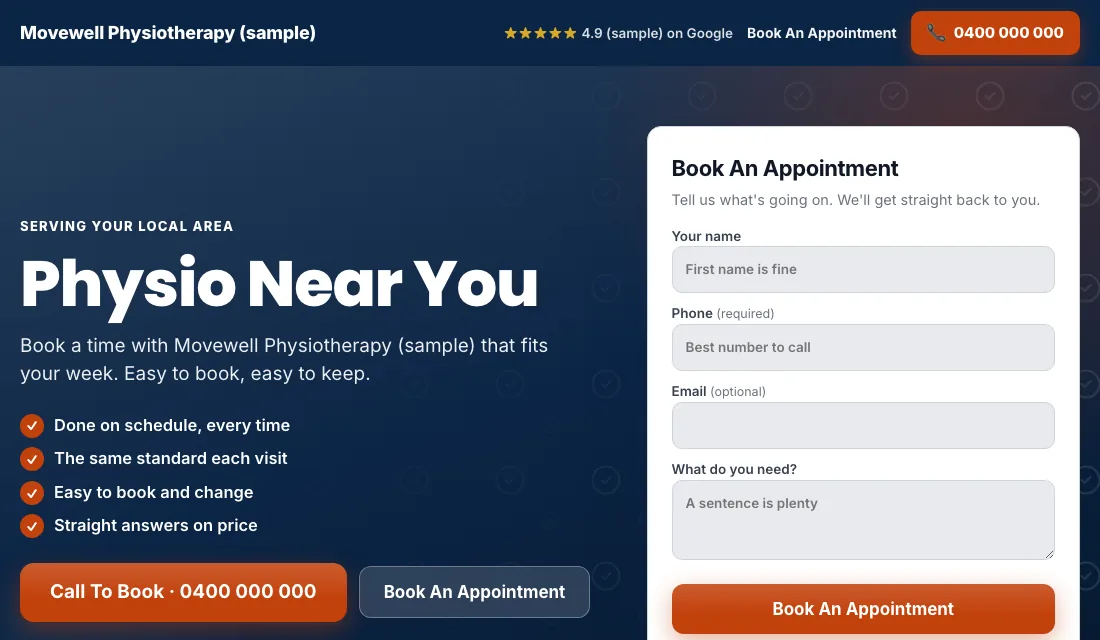
A person in pain is not going to browse. Show them they are in the right place and let them book.
- The headline matches the search. A "sports physio" ad lands on a page headed sports injury physiotherapy.
- A booking button and phone number at the top.
- A short form for people who would rather be called: name, phone, and a line about the problem. Don't ask for medical history on an ad page.
- Photos of the clinic and the practitioners, with names and qualifications.
- Reviews, where your rules allow them.
- What the first visit involves and how long it takes.
- Whether you accept their insurance or what a visit costs, in a line.
- Address, parking and a map. Distance is the reason they picked you.
- No menu and no links leading away.
- Fast on a phone.
Google scores how well the keyword, ad and page match. A closer match earns a higher score and a lower price for the same position.
Budget and bidding for a clinic
Set the budget from the diary. How many new patients can each practitioner take a month? What can you pay for an inquiry, given that a patient usually books several visits? Multiply, and fund it for a couple of months.
Bidding moves in stages:
- Maximize Conversions from the start. With tracking working, launch on this. Google bids toward calls and bookings. Give it two or three weeks.
- If a new account won't spend. As a fallback, use Maximize Clicks with a cap on the bid per click. Return to Maximize Conversions once bookings arrive.
- A target cost per lead. After about 30 conversions in 30 days, set a target, which Google calls Target CPA. Start it 15 to 20 percent above what an inquiry has been costing. Too tight and Google stops spending. Bring it down a little each month while bookings hold.
Don't bid by hand, and don't change things after one quiet week.
How to run Google Ads for physiotherapists week by week
Every week:
- Check the search terms. Block jobs, study, exercises and gear searches.
- Add searches that became appointments as exact match keywords.
- Mark each inquiry: booked, attended or junk.
- Check how many calls reception missed, and when.
Every month:
- Compare cost per booked patient across ad groups.
- See which ad groups brought patients who stayed for a course of treatment.
- Pause an ad group that spends and never books.
- Test the phone number and the online booking.
- If a practitioner's diary is full, lower the budget on their service.
Sports seasons, desk backs and post-op rehab
Demand for physio follows sport, work and surgery lists.
- Start of a sports season: sprains, strains and knees. Check when local football, soccer, basketball and running seasons start, and have the sports ad group ready.
- New Year: people start at the gym and get hurt in the first few weeks.
- Spring: runners and weekend gardeners.
- Busy work periods: long desk days bring neck and back searches.
- Weekends: injuries happen on Saturday, and the booking is made that night or Monday morning. Keep the ads on over the weekend if online booking works.
- All year: post-surgery rehab follows the surgery date, not the season.
Or have software do all of this
That is how to run Google Ads for physiotherapists by hand: count every booking, keep the ads close to the clinic, give each service its own ad group and page, block the students and self-treaters weekly, and step the bidding up as data grows. It works, and it takes time out of a full clinic week.
Local Service Ads AI does these steps every morning and asks before it changes anything unless you tell it to go ahead. See Google Ads for physiotherapists.