Count quote requests before you spend
Google's bidding follows the numbers you give it. With no tracking, it buys clicks. With tracking, it looks for the people who call and ask for a quote.
A conversion is the action you want from a click. For a painter, that is a phone call or a quote request.
- In Google Ads, open Goals, then Conversions, and create a new conversion action.
- Add one for calls from your ads and one for calls from your website. Set a minimum call length so wrong numbers don't count.
- Add one for your quote form, counted when it is sent.
- Mark these as primary, which tells bidding to use them. Mark everything else as secondary.
- Make a test call and send a test form. Both should show in Google Ads within a day.
Then keep a list of every lead. Mark each one: did you quote it, did you win it, and what was the job worth? A whole-house exterior and a call asking if you sell touch-up paint both count as "one call" to Google. Once you have steady volume, upload the quoted and won leads to Google Ads, so bidding learns from jobs and not just rings.
Three settings that stop a painter wasting money
Do these before writing an ad.
- Search only. In campaign settings, open Networks. Untick Search Partners and untick the Display Network. Your ad should show on Google Search for someone typing "house painters near me".
- People who are in your area. Open Locations and add the zip codes or towns where you want to quote. Then open Location options and select "Presence: people in or regularly in your included locations". The default also reaches people who only show interest in your area.
- Auto-apply off. Open Recommendations, find Auto-apply and turn off every box. If it stays on, Google can add keywords and change bidding without asking.
Pick the area with quoting in mind. Every lead is a site visit before it is a job, so a neighborhood forty minutes away costs you an unpaid hour each time.
How to structure a painting campaign
An ad group is a set of keywords that share the same ads. One kind of paint job per ad group, and one landing page for each.
| Ad group | Example searches | Landing page |
|---|---|---|
| Interior painting | interior painters, interior house painting | Your interior page |
| Exterior painting | exterior house painters, exterior painting contractor | Your exterior page |
| Cabinet painting | kitchen cabinet painting, cabinet refinishing painter | Your cabinet page |
| Fence and deck | fence painting, deck staining service | Your fence and deck page |
| Roof painting | roof painting, roof coating painters | Your roof page |
| Rental turnovers | apartment painting, rental repaint | Your property manager page |
| Commercial | commercial painters, office painting | Your commercial page |
| General | painters near me, house painters | Your main painting page |
Build only the ones you want. If you don't paint roofs or cabinets, leave them out.
The mistake to avoid is one ad group with every painting word, sent to the home page. Then an exterior search sees an interior ad and a gallery of bedrooms.
Keywords a homeowner types when they want a painter
A keyword is the phrase you give Google. A search term is what the person typed. You pay for the search term.
Someone ready to hire uses a "who" word, such as painter, painters, contractor, company or service:
- painters near me
- house painters
- interior painters
- exterior house painters
- painting contractor
- kitchen cabinet painting
That "who" word is the difference between a customer and a shopper. "Exterior house painters" wants a crew. "Exterior house paint" wants a can.
Add your town to a few. Keep each ad group to a short list.
Match types tell Google how loosely to match:
- Exact match shows your ad for that search or one with the same meaning.
- Phrase match shows your ad when the search includes the meaning of your phrase, with words around it.
- Broad match shows your ad for anything Google thinks is related, which for painters includes paint colors and stores. Leave it off.
Start with phrase and exact match. Each week, see which search terms became quotes and add them as exact match keywords in the right ad group.
Searches a painter should block from day one
A negative keyword is a word you block. Add these at the account level before the ads run:
- Paint shoppers: store, for sale, gallon, color chart, colors, primer, brush, roller, sprayer, and the big paint brand names.
- DIY: how to, diy, tips, video, ideas.
- Job seekers: jobs, hiring, salary, apprenticeship.
- Students: course, class, school.
- The wrong kind of painting: spray paint, car, auto, face, canvas, art, paint by numbers, nail.
- Other painters' names.
Think before you block "ideas" or "colors" if you offer color consulting. If you don't, block them.
Add each as a phrase match negative, cut down to the core word. "Gallon" catches every search about buying paint by the gallon.
Then check the search terms. Every day or two for the first two weeks, then weekly:
- Open the search terms report under Insights and reports.
- Sort by cost, highest first.
- Ask of each search: would I drive out to quote that?
- If not, block the core word. If it is a job you don't do, such as wallpaper or drywall repair, block that too.
Ads that say the paint job and the town
A responsive search ad takes up to 15 headlines and 4 descriptions. Google mixes them, so fill in as many as you can.
- Say the job: "Exterior House Painters", "Kitchen Cabinet Painting".
- Say the place: your town or the neighborhoods you work.
- Say why you, if it is true: free written quote, licensed and insured, clean job sites, a start date you keep.
- End each description with the next step: "Call for a free quote this week."
Each ad group gets its own ad about that one job. After a few weeks, write a second ad and let the two compete.
Then add the extras, called assets:
- Call asset: your number on the ad for tap to call.
- Sitelinks: at least four, such as "Get a Free Quote", "Interior Painting", "Exterior Painting" and "Our Work".
- Callouts: short phrases such as "Licensed and Insured", "Free Written Quotes" and "Furniture Moved and Covered".
- Images: Google lets you add photos to search ads. A sharp before and after is worth adding.
The landing page: show the finished walls
Painting is visual. The page has to prove you do clean work.
- The headline matches the search. An "exterior house painters" ad lands on a page headed exterior house painting.
- Phone number at the top, tap to call.
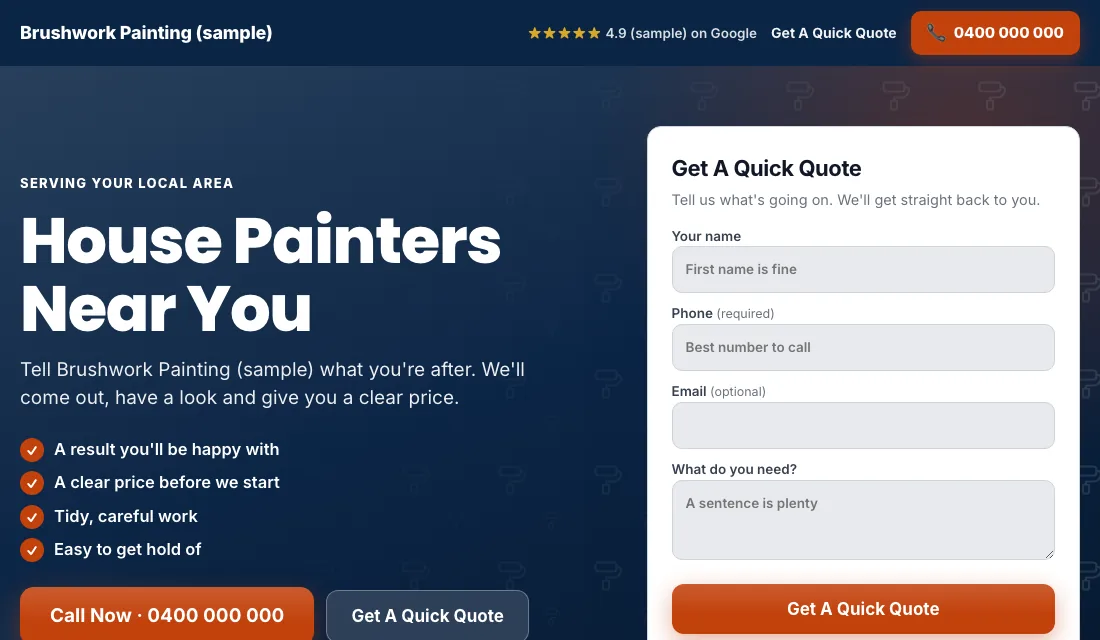
- A short quote form near the top: name, phone, address, and what needs painting.
- Before and after photos of that kind of job. Exterior photos on the exterior page, cabinets on the cabinet page.
- Reviews near the top.
- What is included: prep, patching, primer, cleanup.
- No menu and no links leading away.
- Fast on a phone.
Google scores how well the keyword, ad and page match. A closer match earns a better score and cheaper clicks for the same position.
Budget and bidding for a painting business
Work the budget from your own numbers. How many jobs do you want a month, how many quotes does it take to win one, and what can you pay for a quote request? Multiply through, and fund it for a couple of months.
Bidding moves in stages:
- Start on Maximize Conversions. Once tracking works, launch here. Google bids toward calls and forms. Wait two or three weeks before judging.
- If a brand-new account won't spend. As a fallback, switch to Maximize Clicks with a cap on the bid per click. Return to Maximize Conversions when leads arrive.
- A target cost per lead. After about 30 conversions in 30 days, set a target, which Google calls Target CPA. Put it 15 to 20 percent above what a lead has been costing. A target that is too tight makes Google stop spending. Lower it a little each month while leads hold.
Don't bid by hand, and don't change things on a week of data.
How to run Google Ads for painters: the weekly and monthly routine
Every week:
- Check the search terms and block paint shoppers, DIY and job searches.
- Add searches that became quotes as exact match keywords.
- Mark each lead: quoted, won or junk.
- Call back new leads the same day. Homeowners usually collect two or three quotes, and the first painter to visit has an edge.
Every month:
- Compare cost per lead and cost per won job across ad groups.
- Pause an ad group that spends and never wins work.
- Add fresh before and after photos to the pages.
- Test the phone number and the form.
- Review the budget and the bidding stage.
Dry weather, selling season and rentals
Painting has clear seasons, and they differ by job.
- Late winter and spring: homeowners plan exterior work before the dry weeks arrive. Have the exterior ad group running early, so your quotes are lined up when the weather turns.
- Spring and early summer: owners getting a house ready to sell want it painted before the photos.
- Summer: peak exterior season, and rental turnovers as leases end.
- Fall: deck and fence work before winter, and interiors before the holidays.
- Winter: interiors and cabinets. Shift the budget indoors.
Move the budget between ad groups as the seasons change. You don't need to rebuild anything.
Or have software do all of this
That is how to run Google Ads for painters by hand: count every quote request, lock the settings, give each kind of paint job its own ad group and page, block the paint shoppers weekly, and step the bidding up as the data grows. It works, and it takes time each week.
If you would rather spend that time painting, Local Service Ads AI does these steps every morning. Nothing changes without your OK unless you tell it to go ahead. See Google Ads for painters.