Get tracking right before spring money goes out
Google's bidding heads toward whatever it can count. If it can't see quote requests, it buys cheap clicks, and in landscaping the cheap clicks are people saving backyard photos.
A conversion is the action you want from a click. For a landscaper, that is a call or a quote request.
- In Google Ads, go to Goals, then Conversions, and create a conversion action.
- Add calls from ads and calls from your website, with a minimum call length.
- Add your quote form, counted when it is sent.
- Mark these primary. Gallery views and other small actions are secondary.
- Test with a call and a form, and check both appear within a day.
Keep your own lead list as well. Mark each lead: could you quote it, did it book, and what was the job worth. A retaining wall and a caller asking where to buy mulch look the same to Google. With steady volume, upload the quoted and booked leads so bidding learns from real jobs.
Account settings to fix before the first ad
- Search only. In campaign settings, open Networks and untick Search Partners and the Display Network.
- Your area, presence only. Under Locations, add the cities or zip codes you work. For builds, think about where the yards and budgets suit your work. Under Location options, choose "Presence: people in or regularly in your included locations". The default includes people elsewhere who showed interest in your area.
- Auto-apply off. Under Recommendations, open Auto-apply and untick every box, so Google can't add keywords or change bidding without asking.
For the schedule, run the hours you answer the phone, plus evenings and weekends if your page has a quote form. Homeowners look at the yard on Saturday and search that afternoon.
How to structure a landscaping campaign
An ad group is a set of keywords sharing the same ads. One job per ad group, one landing page per ad group, so a sod search never sees a patio ad.
| Ad group | Example searches | Landing page |
|---|---|---|
| Retaining walls | retaining wall contractor, retaining wall builders | Your retaining wall page |
| Sod and lawns | sod installation, new lawn installation | Your sod page |
| Patios and paving | paver patio installation, patio contractor | Your patio page |
| Landscape design | landscape design and build, backyard landscaping company | Your design page |
| Planting and beds | garden bed installation, planting service | Your planting page |
Give big builds and small jobs their own budgets. In Google Ads the budget sits on the campaign, so put retaining walls and patios in one campaign and sod or planting in another. Then sod jobs can't eat the money meant for the builds.
Leave out what you don't want. If you build and don't maintain, skip mowing. If you don't do irrigation or tree removal, skip those and block them.
Keywords: how to run Google Ads for landscapers without paying for browsers
A keyword is the phrase you give Google. A search term is what was typed.
The bare word "landscaping" is mostly browsers. Ready-to-hire searches add a job and a hiring word:
- landscaping company near me
- retaining wall contractor
- sod installation near me
- paver patio installers
- landscape design and build [your city]
- backyard landscaping contractor
Match types:
- Exact match shows your ad for that search or its close meaning.
- Phrase match shows it when the search includes your phrase's meaning with words around it.
- Broad match shows it for anything Google thinks is related. For landscaping that means ideas, plants and garden centers. Leave it off.
Start with phrase and exact. Each week, add the search terms that became booked jobs as exact match keywords in the right ad group.
Searches a landscaper should block from day one
A negative keyword blocks a search. Add these at the account level before the first click:
- Browsers: ideas, pictures, photos, designs for, inspiration, pinterest.
- DIY: how to, diy, yourself, tutorial, video.
- Job seekers: jobs, hiring, salary, careers, laborer.
- Students: course, classes, degree, certification, license.
- Shoppers: supplies, supply, for sale, nursery, mulch delivery, rocks, blocks, home depot, lowes, rental.
- Software and games: software, app, design tool, free.
- Work you don't do: architect, mowing, tree removal, irrigation, snow, or whatever applies.
- Other companies' names.
Take care with the shopper line. If you sell and deliver mulch or stone, keep those words.
Add each as a phrase match negative, cut down to the core word. "Ideas" blocks "small backyard ideas" and every search like it.
Then check search terms, every day or two for two weeks and weekly after:
- Open the search terms report under Insights and reports.
- Sort by cost, highest first.
- Ask: would I want that call?
- If not, block the core word.
Writing the ads
A responsive search ad takes up to 15 headlines and 4 descriptions.
- Say the job: "Retaining Wall Builders", "Sod Installation".
- Say the area: your city or "Near You".
- Say why you: licensed and insured, free on-site quote, design included, your own crew. Only what is true.
- End with an action: "Request a free quote today."
One ad per ad group, each about its own job. After a few weeks, add a second and let the two compete.
Add the extras, called assets:
- Call asset: your number, for tap-to-call.
- Sitelinks: four or more, such as "Our Projects", "Retaining Walls", "Reviews" and "Get a Quote".
- Callouts: "Free On-Site Quote", "Licensed and Insured", "Locally Owned".
- Image assets: if your account offers them, add photos of finished yards.
The landing page: one job, real photos
Each ad group gets its own page.
- The headline matches the search. "Retaining wall contractor" lands on a retaining wall page.
- Phone number at the top, tap to call.
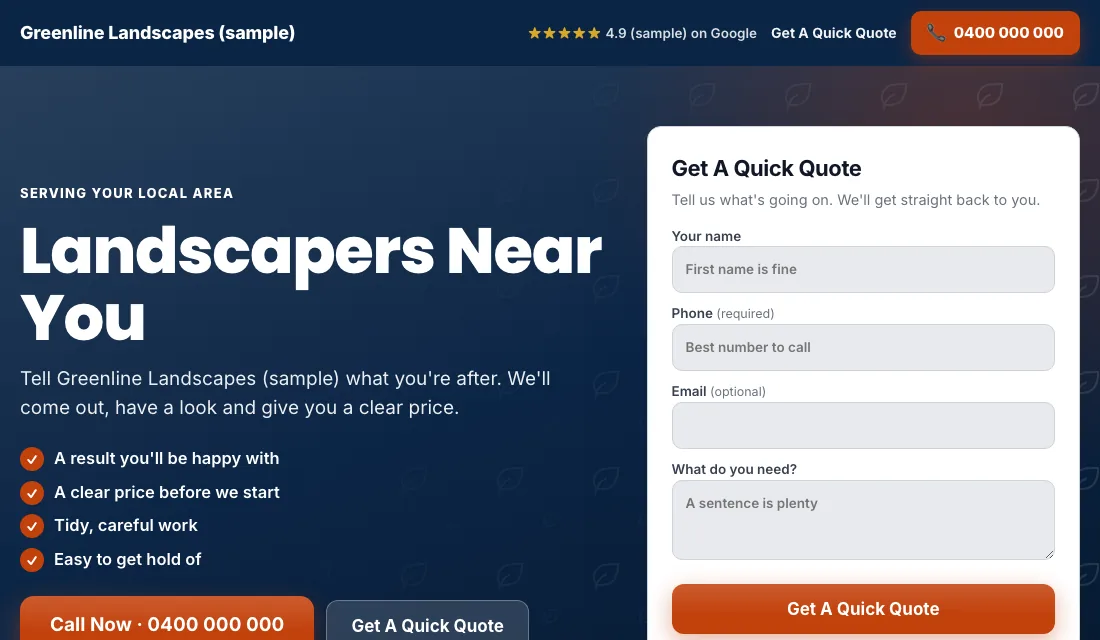
- A short quote form without scrolling: name, phone, address, the job. Let people attach a photo of the yard.
- Photos of your own finished work for that job, with before shots where you have them.
- Real reviews.
- A few lines on how a job runs: site visit, quote, start date.
- No menu and no links away.
- Fast on a phone.
Google scores how well the keyword, ad and page match. A close match means cheaper clicks.
Budget and bidding
Set the budget from leads needed times what you can pay for one. In a seasonal trade, set it by month, not by year.
- Maximize Conversions from the start. With tracking working, Google bids toward calls and quote requests. Give it two to three weeks.
- If a new account won't spend. Switch to Maximize Clicks with a cap on the bid per click. Go back to Maximize Conversions once leads arrive.
- A target cost per lead. After about 30 conversions in 30 days, set a Target CPA 15 to 20 percent above your recent cost per lead. Too tight a target makes Google stop spending. Lower it a little each month while leads hold.
You may only pass 30 conversions in 30 days during spring. That is normal for this trade. Outside the busy months, stay on Maximize Conversions. Don't bid by hand, and don't change things on a week of data.
A weekly and monthly checklist
Weekly, in season:
- Check search terms and block browsers and DIY searches.
- Add searches that became jobs as exact match keywords.
- Mark each lead quoted, booked or junk.
- Get to site visits fast. In spring, the first landscaper to turn up often gets the job.
Monthly:
- Compare cost per lead and cost per booked job, by job type.
- Pause a job type that spends and never books.
- Test tracking with a call and a form.
- Add photos of recently finished jobs.
- Set next month's budget by the season, and review your bidding stage.
Seasons and timing for landscapers
- Late winter: planners. People with a slope that needs a wall or a bare yard start asking for quotes so work can begin when the ground allows. Be live before spring.
- Spring: the rush. Sod, planting, patios, everything. Have the budget raised before the first warm weekend.
- Early summer: lawns to lay before the heat, and patios people want for the season.
- Fall: a second season for sod, planting and hardscape, while the weather is mild.
- Winter: inquiries slow when the cold sets in. Lower the budget, keep the build campaign ticking for people planning ahead, and fill the spring book.
If you run out of crew before you run out of leads, lower the budget or pause the smaller jobs. Paying for leads you can't visit helps nobody.
Or have software do all of this
That is how to run Google Ads for landscapers by hand: count every quote request, lock the settings, one job per ad group, block the idea-hunters, and move budget and bidding with the season. It takes time each week, and the busiest weeks are when you have the least of it.
Local Service Ads AI does these checks each morning and waits for your OK on every change, unless you tell it to go ahead. See Google Ads for landscapers.