Tracking comes first: calls, forms and repeat customers
Google bids toward what it can count. With a small job, you can't afford clicks that go nowhere, so counting has to be right before you spend.
A conversion is the action you want from a click. For a gutter cleaner, that is a call or a quote form.
- In Google Ads, open Goals, then Conversions, and create a conversion action.
- Add calls from your ads and calls from your website, with a minimum call length.
- Add your quote form, counted on sending.
- Mark those primary. Everything else goes to secondary.
- Test with a call and a form, and confirm both show within a day.
Then keep a lead list with three marks: quoted, booked, and whether they signed up for a regular clean. That last mark matters most in this trade. A customer who has you back every fall is worth several times the first job. With steady volume, upload booked leads to Google Ads so bidding learns which searches bring paying houses.
Account settings: only where you'll climb
- Search only. Under Networks, untick Search Partners and the Display Network.
- A tight area, presence only. Under Locations, add the zip codes or neighborhoods you want. Keep it small. Driving forty minutes for one gutter clean wipes out the job. Then, under Location options, choose "Presence: people in or regularly in your included locations". The default shows ads to people elsewhere who once looked up your area.
- Auto-apply off. Under Recommendations, open Auto-apply and untick everything, so Google can't add keywords or change bidding for you.
Set the schedule to the hours you answer the phone. If you are on a roof all day, a quote form on the page lets leads wait until evening.
How to structure a gutter cleaning campaign
An ad group is a set of keywords sharing the same ads. One service per ad group, one page per ad group.
| Ad group | Example searches | Landing page |
|---|---|---|
| Gutter cleaning | gutter cleaning near me, gutter cleaning service | Your gutter cleaning page |
| Gutter guards | gutter guard installation, leaf guard installers | Your gutter guard page |
| Downspouts | clogged downspout, downspout cleaning | Your downspout page |
| Solar panel cleaning | solar panel cleaning service | Your panel cleaning page, if you offer it |
Most of the volume will sit in the first ad group. That is fine. The others are there so a gutter guard search sees a gutter guard ad, and so you can give the bigger jobs their own budget.
Only build for work you do. If you don't replace gutters or repair roofs, leave those out and block them.
Keywords: what a homeowner with full gutters types
A keyword is the phrase you ask Google to match. A search term is what was typed.
Searches from people ready to hire:
- gutter cleaning near me
- gutter cleaning service
- gutter cleaners [your city]
- gutter guard installation
- clogged downspout cleaning
- gutter cleaning cost
That last one is worth keeping. Someone asking what a clean costs is usually pricing a service, not planning to do it themselves.
Match types:
- Exact match shows your ad for that search or its close meaning.
- Phrase match shows it for searches containing your phrase's meaning with extra words.
- Broad match shows it for anything related, which here includes ladders, tools and roof repairs. Leave it off.
Start with phrase and exact. Each week, add search terms that became booked cleans as exact match keywords.
Clicks to block from day one
A negative keyword blocks a search. Add these at the account level before launch:
- DIY: how to, diy, yourself, video, tips.
- Tool shoppers: tools, vacuum, wand, attachment, ladder, rental, for sale, home depot, lowes.
- Job seekers: jobs, hiring, salary, pay.
- Business starters: start a business, business plan, pricing guide, insurance.
- Work you don't do: replacement, repair, roof, if those belong to a roofer and not you.
- Other companies' names.
Be careful with that fifth line. If you install or repair gutters, don't block those words.
Add each as a phrase match negative, trimmed to the core word. Block "rental", not "gutter vacuum rental near me".
Then check search terms, every day or two for two weeks and weekly after:
- Open the search terms report under Insights and reports.
- Sort by cost.
- Ask of each: is this a homeowner who wants someone to do it?
- If not, block the core word.
Writing ads that say the job and the neighborhood
A responsive search ad takes up to 15 headlines and 4 descriptions. Fill in as many as you can.
- Say the job: "Gutter Cleaning Service", "Gutter Guards Installed".
- Say the place: your city or neighborhood.
- Give a reason: insured, photos before and after, downspouts flushed, a fixed price by house size if you offer one. Only true claims.
- End with an action: "Get a quote today."
Write one ad per ad group. A few weeks in, add a second and let them compete.
Add the extras, called assets:
- Call asset: tap-to-call on the ad.
- Sitelinks: four or more, such as "Get a Quote", "Gutter Guards", "Before and After" and "Areas We Cover".
- Callouts: "Fully Insured", "Downspouts Flushed", "Yearly Plans".
The landing page: one job, a fast quote
Send each ad group to its own page.
- The headline matches the search: gutter cleaning in your city.
- Phone number at the top, tap to call.
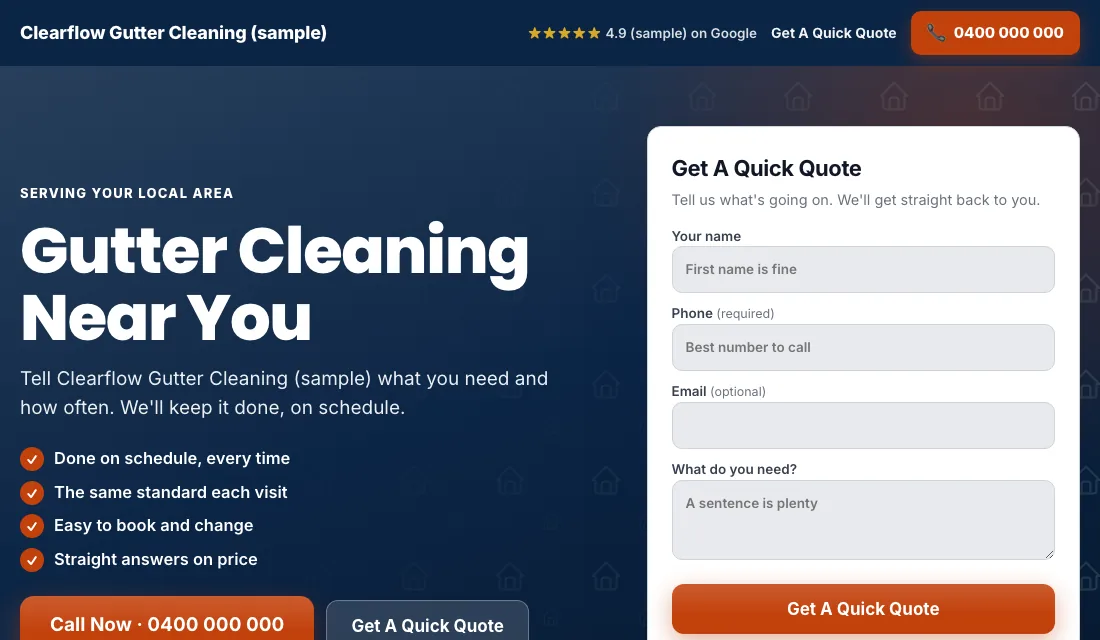
- A short quote form without scrolling: name, phone, address, one or two stories.
- Before and after photos of gutters you cleaned. A gutter packed with leaves next to a clear one does the selling.
- Real reviews from nearby streets.
- A line that you are insured. People worry about someone falling off their roof.
- An offer of a yearly or twice-yearly plan.
- No menu and no links away.
- Fast on a phone.
Google scores the match between keyword, ad and page. A close match means cheaper clicks, and with a small job, cheaper clicks decide whether the ads pay.
Budget and bidding for a seasonal job
Work out the budget from leads needed and what you can pay per lead. Remember to count the value of repeat customers, not only the first clean. Set a daily budget and change it yourself as the season moves.
- Maximize Conversions from the start. With tracking working, Google bids toward calls and forms. Give it two to three weeks.
- If a new account won't spend. Switch to Maximize Clicks with a cap on the bid per click. Go back once leads arrive.
- Target cost per lead. After about 30 conversions in 30 days, set a Target CPA 15 to 20 percent above your recent cost per lead. Too tight and Google stops spending. Lower it a little each month while leads hold.
A seasonal trade may only reach 30 conversions in 30 days during the busy waves. That is normal. Stay on Maximize Conversions the rest of the time. Never bid by hand.
The routine: how to run Google Ads for gutter cleaning through the year
Weekly, in season:
- Check search terms and block junk.
- Add searches that became jobs as exact match keywords.
- Mark each lead quoted, booked, or signed up for a plan.
- Group new bookings by neighborhood so the truck isn't crossing town.
Monthly:
- Compare cost per lead and cost per booked job.
- Test tracking with a call and a form.
- Check the weather outlook and set next month's budget.
- Pause an ad group that spends and never books.
- Review your bidding stage.
Seasons and timing for gutter cleaning
This trade lives by the calendar.
- Fall: leaf drop is the main wave. Have campaigns live and funded before the leaves start to come down.
- Spring: people clear out what winter left and get ready for spring rain.
- The first big storm: water pours over the edge and the phone rings. Keep some budget in reserve to raise for a few days.
- Deep winter and midsummer: quieter in most places. Lower the budget, or use the time to push gutter guards, which sell year round.
Raise the budget a week or two ahead of each wave. If you raise it after, you have missed the start.
Or have software watch it for you
That is how to run Google Ads for gutter cleaning yourself: count every lead, keep the area tight, block the tool shoppers and DIY-ers, and move the budget with the season. It is not hard, but it needs doing every week you are busiest.
Local Service Ads AI does those checks each morning and asks you before any change, unless you tell it to go ahead. Your daily budget stays the one you set. See Google Ads for gutter cleaning.