Before you spend: count calls, forms and bookings
Google's bidding buys more of whatever it sees working. If it can't see which clicks became bookings, it buys the cheap ones. In detailing, cheap clicks are product shoppers and people looking for a drive-through wash.
A conversion is the action you want after a click. For a detailer that is a call, a quote form, or a booking made online.
- In Google Ads, open Goals, then Conversions, and create a new conversion action.
- Add one for calls from your ads and one for calls from your website. Set a minimum call length so a wrong number isn't counted.
- Add one for your quote or booking form, counted when it is sent. If you use an online booking tool, count the confirmed booking, not the visit to the calendar.
- Mark those primary, which means bidding uses them. Mark everything else secondary.
- Test each one. Check it shows in Google Ads within a day.
Many detailing customers prefer to text. If you offer a text number, treat those messages as leads in your own list, even though Google won't count them unless your tracking does.
Keep that list simple: for each lead, could you quote it, did they book, which service, and what was it worth? A ceramic coating and a basic interior clean are both "one lead" to Google. When volume is steady, upload the booked leads so bidding learns from real jobs.
Account settings that stop a detailer wasting money
- Search only. In campaign settings, open Networks. Untick Search Partners and untick the Display Network. Your ad belongs on Google Search, beside "car detailing near me".
- People in your area. Open Locations and add your cities or zip codes. In Location options, choose "Presence: people in or regularly in your included locations". The default also reaches people who are only interested in your area.
- Auto-apply off. Open Recommendations, find Auto-apply, and turn every box off. Otherwise Google can add keywords and change bidding on its own.
For a mobile detailer, the area is the most important setting in the account. A booking 40 minutes past your last job eats the morning. Start with the zip codes you already work in and add more only when those are full.
Set the ad schedule to hours when you can answer or reply quickly. A detailer is often mid-job with wet hands, so decide who answers, or run ads in the hours you can.
How to structure a car detailing campaign
An ad group is a set of keywords that share the same ads. Interior details, paint correction and ceramic coating are different jobs at different prices. Each gets its own ad group and landing page.
| Ad group | Example searches | Landing page |
|---|---|---|
| Full detail | car detailing near me, full car detail | Your full detail page |
| Interior detail | interior car detailing, car seat shampoo service | Your interior page |
| Mobile detailing | mobile car detailing, mobile detailer near me | Your mobile page |
| Ceramic coating | ceramic coating near me, ceramic coating installer | Your coating page |
| Paint correction | paint correction near me, swirl mark removal | Your correction page |
| Odor and stain removal | car odor removal service, smoke smell removal car | Your odor page |
If you do both mobile and shop work, split them into two campaigns, each with its own area. If coatings matter to you, give them a campaign too, so a busy week of basic details can't use up the coating budget.
Leave out anything you don't do. If you don't tint windows, wrap cars or fix dents, don't let those searches in.
Keywords: what a ready-to-book customer types
A keyword is the phrase you give Google. A search term is what the person typed. You pay for the search term.
Ready-to-book searches name the service and usually the place:
- car detailing near me
- mobile car detailing
- interior car detailing near me
- ceramic coating near me
- paint correction service
Add your city to a few. Keep each ad group to a short, tight list.
Match types set how loosely Google matches:
- Exact match shows your ad for that search or one with the same meaning.
- Phrase match shows your ad when the search includes the meaning of your phrase, with other words around it.
- Broad match shows your ad for anything Google finds related: car washes, wax products, pressure washers. Leave it for now.
Start with phrase and exact. Each week, add the search terms that became bookings as exact match keywords in the right ad group.
Searches to block from day one
A negative keyword is a search you block. Detailing has a big hobby crowd who search the same words as your customers. Add these at the account level before the first click:
- Product shoppers: kit, supplies, products, for sale, buy, spray, wax, polisher, pressure washer.
- DIY: how to, diy, video, tutorial, at home.
- Students and job seekers: course, training, class, certification, jobs, hiring, salary.
- Starting a business: business plan, start a detailing business, franchise, equipment.
- Wash shoppers: car wash, self serve, drive through, unlimited, coupon. Skip this group if you also run a wash.
- Jobs you don't do: tint, wrap, dent, body shop, boat, rv.
A caution on "wax" and "ceramic": don't block the word "ceramic" if you install coatings. Block "diy ceramic" and "ceramic spray" and leave the word itself alone.
Add each as a phrase match negative, trimmed to the core word. Block "kit", not "car detailing kit for beginners".
Then check the search terms. Every day or two for the first two weeks, then weekly:
- Open the search terms report under Insights and reports.
- Sort by cost, highest first.
- Ask: would that person book?
- If not, block the core word.
Writing the ads
A responsive search ad takes up to 15 headlines and 4 descriptions, which Google mixes. Fill in as many as you can.
- Say the service: "Full Interior Detail", "Ceramic Coating", "Mobile Detailing".
- Say the area, or "We Come to You" for mobile work.
- Say why you: insured, years detailing, a coating warranty, easy booking. Only what is true.
- Give the reason to act: "Selling Your Car? Detail It First", "Protect Your New Car".
- End with the next step: "Book online or call today."
Write the coating ad for a different person than the interior ad. A coating buyer cares about the car and wants proof of skill. A parent with a spilled milkshake wants it gone this week.
Add the extras, which Google calls assets:
- Call asset: your number on the ad for tap-to-call.
- Sitelinks: at least four, such as "Packages", "Ceramic Coating", "Before and After" and "Book Now".
- Callouts: short phrases such as "Mobile Service", "Fully Insured" or "Easy Online Booking".
- Image assets: your own before and after photos, where Google offers them.
The landing page: one service per page
Detailing is a visual sale. Build one page per ad group.
- The headline matches the search: "Paint Correction in" your city.
- The phone number is at the top and starts a call when tapped. Add a text option if you take texts.
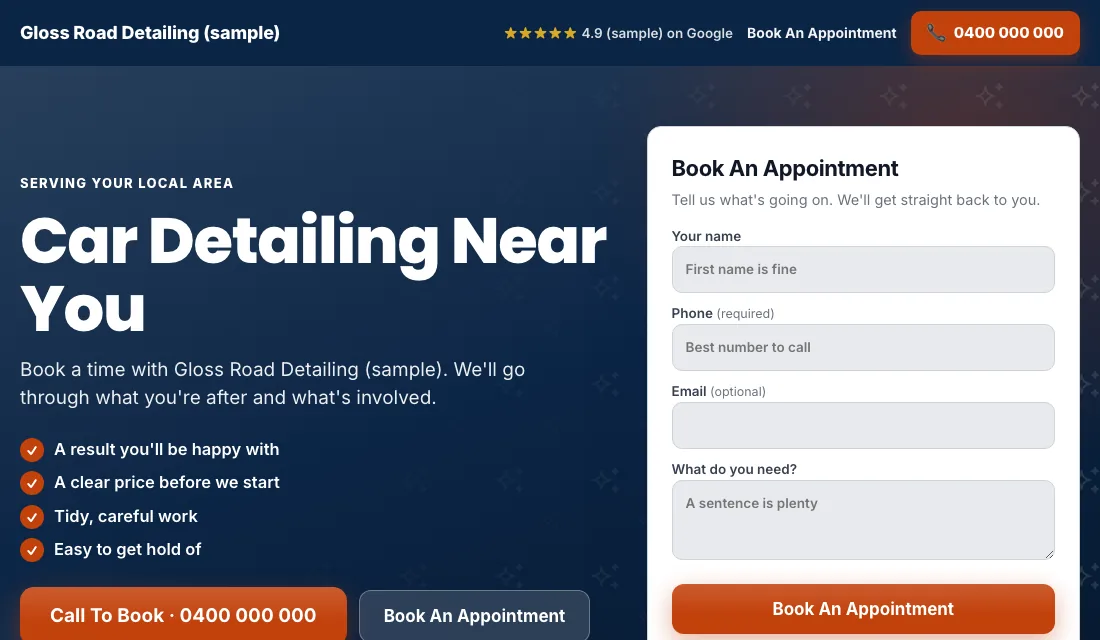
- A short form or booking button shows without scrolling: name, phone, the car's make and model, the service, and a zip code for mobile work.
- Before and after photos of your own work: the swirled hood, then the gloss. This sells more than any sentence.
- Real reviews near the top.
- What each package includes, in a plain list.
- For mobile work, what you need on site, such as a parking space, water or power.
- No menu and no links away.
- It loads fast on a phone, with photo files kept small.
Google scores how well keyword, ad and page match. A closer match earns a higher score, and that lowers what you pay for the same spot.
Budget and bidding as bookings grow
Start from your own numbers. How many bookings do you want from ads each month, how many leads does that take, and what can you pay per lead? A basic detail can only carry a small cost per lead. A coating can carry far more. That is another reason to keep them apart.
- Conversions from the start. With tracking working, start on Maximize Conversions, so Google bids toward calls, forms and bookings. Give it two or three weeks.
- If a new account won't spend. A new account can stall with no history. Use Maximize Clicks with a cap on the bid per click, and return to Maximize Conversions once leads arrive.
- A target cost per lead. After about 30 conversions in 30 days, set a target cost per lead, which Google calls Target CPA, 15 to 20 percent above what leads have cost. Set it too low and the ads stop showing. Tighten it a little each month.
Never bid by hand, and don't change bids or budgets on a week of data.
How to run Google Ads for car detailing through the week
Every week:
- Check the search terms and block shoppers and DIY.
- Add searches that became bookings as exact match keywords.
- Mark each lead: quoted, booked or junk, with the service.
- Reply to missed calls and texts fast. Someone with a free Saturday books the first detailer who answers.
Every month:
- Compare cost per lead and cost per booking for each service.
- Pause an ad group that spends and never books, or fix its page.
- Test your call and form tracking.
- Add fresh before and after photos.
- Review your bidding stage and budget.
Seasons and timing for car detailing
- Spring: the main rush. Winter grime and road salt come off, and people want the car fresh. Raise the budget before the first warm weekend.
- Early summer: road trips and beach vacations, then the interior clean afterward. Sand, sunscreen and spilled drinks.
- Fall: paint protection before winter. A good time for coatings and sealants.
- Winter: slower for mobile work in cold places. Shop-based interior details and coatings keep going. Lower the mobile budget instead of pausing it.
- All year: people selling a car, returning a lease, or picking up a new one they want protected.
Weather matters week to week. A mobile detailer can lower the budget when a week of rain is forecast and raise it for the dry spell after.
Bookings cluster before weekends. Many people search midweek for a Friday or Saturday slot, so be visible Tuesday to Thursday.
Or have software do all of this
That is how to run Google Ads for car detailing by hand: count every booking, lock the settings, keep each service in its own ad group with its own page, block the hobby searches weekly, and step your bidding up as the data grows. It works, and it takes time each week.
If you'd rather spend that time on cars, Local Service Ads AI does these steps for you every day. Nothing changes without your OK unless you tell it to go ahead. See Google Ads for car detailing.