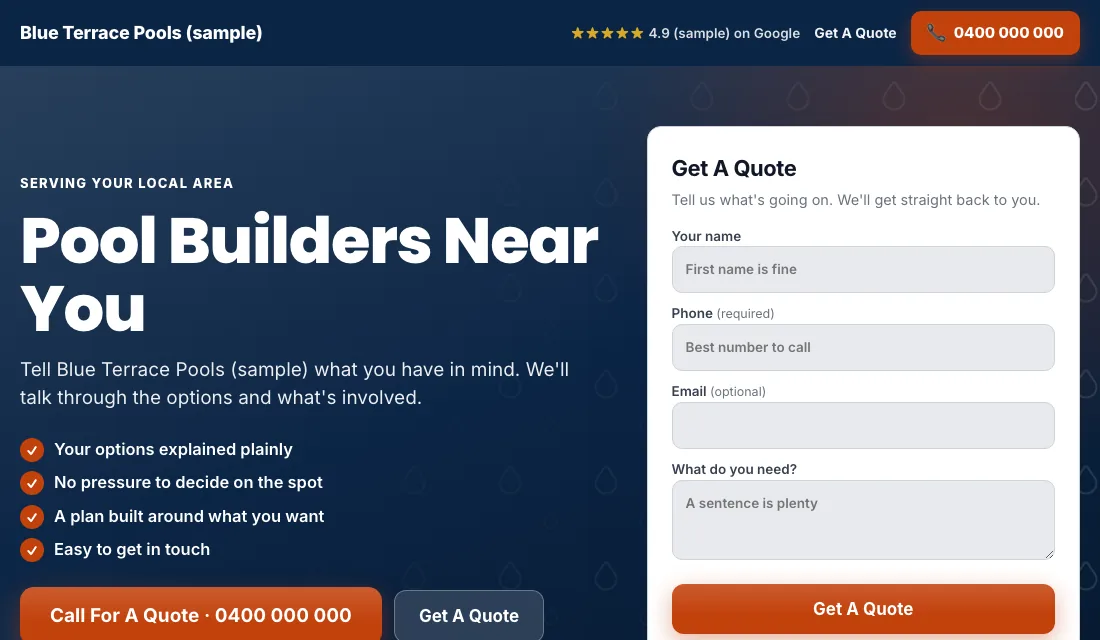
Track inquiries, site visits and signed contracts
Google's bidding chases what it can count. A pool builder gets few leads and each one matters, so counting the wrong thing does real damage.
A conversion is the action you want from a click. For a pool builder, that is a call or a quote request.
- In Google Ads, open Goals, then Conversions, and create a new conversion action.
- Add one for calls from your ads and one for calls from your website. Set a minimum call length. A real pool inquiry is a conversation, not a thirty-second call.
- Add one for your quote or consultation form, counted when it is sent.
- Mark these as primary, so bidding uses them. Mark brochure downloads, gallery views and anything else as secondary.
- Make a test call and send a test form. Both should appear in Google Ads within a day.
Then keep a list of every lead and follow it for months. Does the caller own the home? Is there room in the yard? Did you visit the site, send a design, sign a contract? What was the contract worth? A signed pool and a call about pool chemicals are both "one call" to Google. When you have enough history, upload the qualified and signed leads to Google Ads, with their value, so bidding learns what a real buyer looks like.
Settings that keep a pool builder's budget in the right yards
Fix three settings before any ad runs.
- Search only. In campaign settings, open Networks. Untick Search Partners and untick the Display Network. You want your ad on Google Search when someone types "pool builders near me".
- People who are in your build area. Open Locations and add the cities or zip codes where you build. Then open Location options and choose "Presence: people in or regularly in your included locations". The default also includes people who only showed interest in the area.
- Auto-apply off. Open Recommendations, find Auto-apply and turn off every box. Otherwise Google can add keywords and change bidding without asking.
Choose the area by where you want to build, not just where you can drive. If some zip codes are mostly small lots or rentals, leave them out.
How to structure a pool building campaign
An ad group is a set of keywords that share the same ads. One pool type per ad group, one landing page for each.
| Ad group | Example searches | Landing page |
|---|---|---|
| Concrete pools | concrete pool builders, gunite pool builder | Your concrete pool page |
| Fiberglass pools | fiberglass pool installers, fiberglass pool builders | Your fiberglass page |
| Plunge pools | plunge pool builder, small pool for small backyard builder | Your plunge pool page |
| Pool renovations | pool remodeling, pool resurfacing | Your renovation page |
| General | pool builders near me, inground pool contractors | Your main pool page |
Build the ones you sell. If you only install fiberglass, don't build a concrete ad group, and add "gunite" and "concrete" to your blocked words.
Because pool leads are few, keep these ad groups in one campaign to start. That way Google's bidding learns from all of them together. Give renovations their own campaign later if you want a separate budget for them.
Keywords a homeowner types when they are ready for quotes
A keyword is the phrase you give Google. A search term is what the person typed. You pay for the search term.
A buyer looking for a builder uses a "who" word, such as builder, contractor, company or installer:
- pool builders near me
- inground pool contractors
- fiberglass pool installers
- custom pool builder
- plunge pool builder
- pool remodeling company
Without the "who" word, the search is mostly research. "Inground pool" alone brings people looking at pictures and prices. They may buy one day, but you pay for a lot of browsing to find them.
Add your city to several. Keep each ad group short.
Match types set how loosely Google matches:
- Exact match shows your ad for that search or one with the same meaning.
- Phrase match shows your ad when the search contains the meaning of your phrase, with other words around it.
- Broad match shows your ad for anything Google considers related, which for pools covers supplies, cleaning and toys. Leave it off.
Start with phrase and exact match. Each week, see which search terms became real inquiries and add them as exact match keywords in the right ad group.
Searches a pool builder should block from day one
A negative keyword is a word you block. Add these at the account level before you go live:
- Pools you don't build: above ground, inflatable, kit, stock tank, container.
- DIY: diy, how to build, build your own, plans.
- Pool store customers: supplies, chemicals, chlorine, pump, filter, cover, liner, parts, for sale.
- Other pool services: cleaning, maintenance, service, repair, leak, if you don't offer them.
- Job seekers: jobs, hiring, salary, careers.
- Not a backyard pool: public pool, hotel, swim lessons, pool table, pool hall.
- Other builders' names.
Be careful with "liner" if you build vinyl liner pools, and with "repair" if you do renovations.
Add each as a phrase match negative, trimmed to the core word. "Above ground" stops every version of that search.
Then check the search terms. Every day or two for the first two weeks, weekly after that:
- Open the search terms report under Insights and reports.
- Sort by cost, highest first.
- Ask of each search: could this person sign a contract for a pool I build?
- If not, block the core word.
Writing ads for a pool builder
A responsive search ad takes up to 15 headlines and 4 descriptions. Google mixes them. Fill in as many as you can.
- Say what you build: "Custom Inground Pools", "Fiberglass Pool Installers".
- Say where: your city or region.
- Give true reasons to shortlist you: licensed and insured, years building locally, design included, financing options available, a warranty.
- End each description with the next step: "Book a free backyard consultation."
Words like "custom" and "inground" in the headline do some filtering for you. Someone after a cheap above ground pool is less likely to click.
Each ad group gets its own ad. After a few weeks, add a second and let them compete.
Then add the extras, called assets:
- Call asset: your number on the ad, tap to call.
- Sitelinks: at least four, such as "Our Pools", "Book a Consultation", "Financing" and "Reviews".
- Callouts: short phrases such as "Licensed and Insured", "3D Design Included" and "Locally Owned", if true.
- Images: a finished pool sells itself. Add your own photos.
The landing page: photos, proof and a consultation form
Nobody buys a pool on the first visit. The page's job is to get you onto the shortlist of builders they ask for a quote.
- The headline matches the search. A "plunge pool builder" ad lands on a page headed plunge pools.
- Phone number at the top, tap to call.
- A consultation form near the top: name, phone, address, pool type, and when they hope to swim. Those extra questions screen out people who aren't serious.
- Your own finished pools, large and sharp. Before and after for renovations.
- Reviews from homeowners near the top.
- The steps from first visit to first swim, in plain words.
- License, insurance and warranty details.
- No menu and no links leading away.
- Fast on a phone, even with the photos.
Google scores how well the keyword, ad and page match. A closer match earns a higher score and cheaper clicks for the same position.
Budget and bidding when one job is a whole pool
Work the budget from contracts. How many pools do you want from ads this year? How many inquiries does it take to sign one? What can you afford to pay for an inquiry? Multiply it through, and plan to fund it for a full season, not a month.
Bidding moves in stages:
- Maximize Conversions from the start. With tracking working, launch on this setting. Google bids toward calls and forms. Give it several weeks, since pool leads arrive slowly.
- If a new account won't spend. As a fallback, use Maximize Clicks with a cap on the bid per click. Go back to Maximize Conversions when inquiries arrive.
- A target cost per lead. After about 30 conversions in 30 days, you can set a target, which Google calls Target CPA. Start 15 to 20 percent above what an inquiry has been costing. Too tight and Google stops spending. Lower it a little each month while inquiries hold. Many pool builders never reach that volume, and that is fine. Stay on Maximize Conversions.
Don't bid by hand. And don't panic in a week with no inquiries. With few leads, quiet weeks are normal.
How to run Google Ads for pool builders, week by week
Every week:
- Check the search terms. Block above ground, supplies and DIY searches.
- Add searches that became real inquiries as exact match keywords.
- Update each lead: qualified, site visit, design sent, signed or junk.
- Follow up the inquiries from earlier weeks. Pool buyers go quiet and come back.
Every month:
- Look at cost per qualified inquiry, not just cost per lead.
- Look back three to six months. Which ad groups led to signed pools?
- Pause an ad group that spends and brings only junk.
- Add new project photos to the pages.
- Test the phone number and the form.
Seasons: the pool is searched for long before it is dug
- Late winter: planning starts. Families who want to swim next summer begin looking. Have the ads running by now.
- Spring: the busiest inquiry months. Quotes are collected and compared.
- Early summer: people who left it late. Be honest in your ads and calls about build times.
- Late summer and fall: buyers planning for next year, often less rushed and easier to schedule. Renovation inquiries pick up as pools close.
- Winter: quiet in cold regions, steady in warm ones.
Because the decision is long, stay visible between the first click and the signature. Answer fast, follow up, and keep the ads running so they find you again when they search a second time.
Or have software do all of this
That is how to run Google Ads for pool builders by hand: follow every lead to a signed contract, lock the settings, give each pool type its own ad group and page, block the above ground and supply searches weekly, and let the bidding learn at its own pace. It works, and it takes attention across a long season.
Local Service Ads AI does these steps every morning, and every budget change waits for your OK. See Google Ads for pool builders.