Track consultations before you pay for a click
Google's bidding goes after whatever you tell it to count. If you count nothing, or count page views, it buys the lowest-priced clicks it can find. In legal searches, those are students and people looking for free forms.
A conversion is the action you want from a click. For a firm, that is a phone call or an inquiry form.
- In Google Ads, open Goals, then Conversions, and create a new conversion action.
- Add one for calls from the ad and one for calls from your website. Set a minimum call length. A real inquiry about a divorce is not a ten-second call.
- Add one for your inquiry form, counted when the form is sent.
- Mark these as primary, so bidding uses them. Mark anything else as secondary.
- Make a test call and send a test form. Check that both appear in Google Ads within a day.
Then keep a simple intake list. For every inquiry, note three things. Was it in your practice area and your state? Did it book a consultation? Did it become a matter? A call asking for free advice and a call that becomes a contested estate both look like "one call" to Google. Once you have steady volume, upload the qualified and signed inquiries to Google Ads, so bidding learns from the people who became clients. Share only what the upload needs, and keep client details confidential.
Account settings that protect a firm's budget
These three settings take five minutes and prevent most of the waste.
- Search only. In campaign settings, open Networks. Untick Search Partners and untick the Display Network. You want your ad on Google Search results, beside a search like "divorce lawyer near me".
- People who are in your area. Open Locations and add the cities, counties or zip codes you serve. Then open Location options and select "Presence: people in or regularly in your included locations". The default also includes people who only show interest in your area. For a firm licensed in one state, a click from three states away is a click you can't help.
- Auto-apply off. Open Recommendations, then Auto-apply, and turn off every box. Otherwise Google can add keywords and change bidding without asking.
Set your ad schedule to the hours your phones are answered. If nobody picks up after 6 p.m., either stop the ads then or make sure the form is easy to send and someone replies first thing in the morning.
One practice area per ad group
An ad group is a set of keywords that share the same ads. The rule for a law firm is one practice area per ad group, and one landing page per ad group. Family law, estates and injury claims are different clients with different worries.
| Ad group | Example searches | Landing page |
|---|---|---|
| Divorce | divorce lawyer, divorce attorney near me | Your divorce page |
| Child custody | child custody lawyer, custody attorney | Your custody page |
| Wills and estates | estate planning attorney, wills lawyer | Your estate planning page |
| Probate | probate lawyer, probate attorney near me | Your probate page |
| Real estate | real estate attorney, closing attorney | Your real estate page |
| Injury claims | personal injury lawyer, car accident lawyer | Your injury page |
Build only the ones you want more of. If you don't take criminal or immigration matters, leave them out and block those words, as described below.
For a bigger firm, each practice area can be its own campaign with its own budget. That stops a busy divorce ad group from using the money you meant for probate.
Keywords a paying client types
A keyword is the phrase you give Google. A search term is what the person typed. They differ, and you pay for the search term.
People ready to hire a lawyer name the kind of lawyer, and often the place:
- divorce lawyer near me
- child custody attorney
- probate lawyer
- estate planning attorney near me
- car accident lawyer
Use both "lawyer" and "attorney". People type both, and it varies by region. Add your city to a few. Keep each ad group to a short list of close phrases.
Match types set how loosely Google matches:
- Exact match shows your ad for that search or one with the same meaning.
- Phrase match shows your ad when the search includes the meaning of your phrase, with extra words around it.
- Broad match shows your ad for anything Google considers related. For legal keywords that pulls in law school searches and general questions. Leave it off.
Start with phrase and exact match. Each week, look at which search terms became consultations. Add those as exact match keywords in the right ad group.
Searches a law firm should block from day one
A negative keyword is a word you block. Legal searches are full of people who will never retain you. Add these as account-level negatives before the ads run:
- Free help: free, pro bono, legal aid.
- Careers: jobs, salary, hiring, paralegal, internship.
- Students: law school, degree, bar exam, course.
- Doing it themselves: template, form, sample, how to, without a lawyer.
- Practice areas you don't take: for example criminal, immigration, bankruptcy.
- Other firms' names.
One caution. If you offer a free first consultation and want those searches, don't block "free". Block "free legal advice" and "legal aid" instead.
Add each as a phrase match negative, trimmed to the core word. "Paralegal" catches "paralegal salary", "paralegal jobs" and "paralegal course" in one line.
Then do the search-term check. Every day or two for the first two weeks, then weekly:
- Open the search terms report under Insights and reports.
- Sort by cost, highest first.
- For each search, ask: could this person become a paying client in my practice area?
- If not, block the core word.
In legal accounts, a single wrong search can cost as much as a week of clicks in another business, so this check pays for itself.
Writing ads for a law firm
A responsive search ad takes up to 15 headlines and 4 descriptions. Google mixes them, so give it plenty.
- Name the practice area: "Divorce Lawyer", "Probate Attorney".
- Name the place: your city or county.
- Say what a worried person wants to hear, as long as it is true: speak to a lawyer today, clear fees explained up front, years in practice.
- End each description with the next step: "Call to book a consultation."
Stay with facts. Don't promise outcomes, and don't use claims you can't back up. Lawyers answer for their advertising, so check your own regulator's advertising rules before the ads go live, and read every ad yourself.
Write one ad per ad group about that practice area only. After a few weeks, add a second and let them compete.
Then add the extras, called assets:
- Call asset: your number on the ad, tap to call.
- Sitelinks: at least four extra links, such as "Book a Consultation", "Our Attorneys", "Fees" and "Client Reviews".
- Callouts: short facts such as "Licensed in [your state]", "Evening Appointments" or "Payment Plans Available", if they are true.
The landing page for each practice area
A person searching for a custody lawyer is often anxious and in a hurry. The page they land on should answer one question: can this firm help me with this?
- The headline matches the search. A "child custody lawyer" ad lands on a page headed child custody lawyer.
- The phone number is at the top and starts a call when tapped.
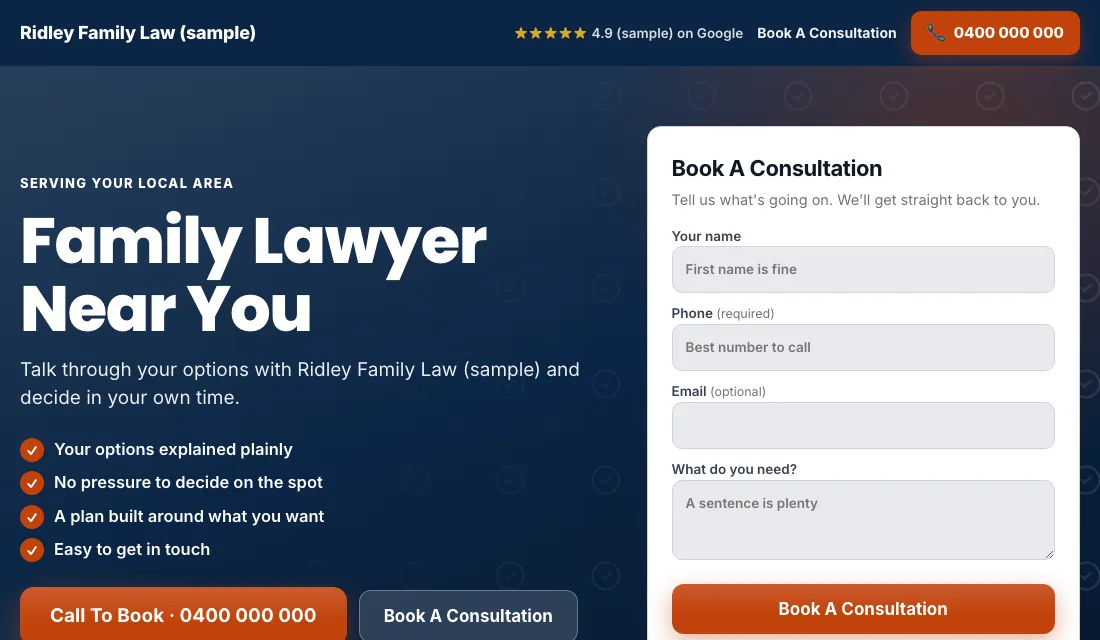
- A short inquiry form is visible without scrolling: name, phone, and a line about the matter. Don't ask for the whole story.
- A photo of the lawyer they will speak to, with a name and a short bio. People hire a person.
- Reviews, where your rules allow them.
- A plain line on what the first consultation costs and how long it takes.
- No site menu and no links away. Call or send the form.
- Fast and easy to read on a phone.
Add a short note that sending the form does not create an attorney-client relationship, if your rules call for one.
Google scores how well keyword, ad and page match. A close match earns a higher score, and a higher score lowers what you pay for the same position. With legal click prices, that matters.
Budget and bidding for a law firm
Work out the budget from your own numbers. How many new matters do you want each month in this practice area? About how many inquiries does it take to sign one? What can you afford to pay for an inquiry? Multiply it out, and fund it for a couple of months.
Bidding then moves in stages:
- Maximize Conversions from the start. Once tracking is working, launch on this setting. Google bids toward calls and forms. Give it two or three weeks before you judge.
- Fallback if a new account won't spend. Some brand-new accounts have too little history. Switch to Maximize Clicks with a cap on the price of each click, and return to Maximize Conversions once inquiries are arriving.
- Target cost per lead. After about 30 conversions in 30 days, you can set a target, which Google calls Target CPA. Put it 15 to 20 percent above what an inquiry has been costing you. Too tight a target makes Google hold back. Tighten it a little each month while inquiries hold steady.
If one practice area can't reach about 30 conversions a month on its own, keep the practice areas in one campaign so they learn together. Don't bid by hand, and don't change settings on a few days of data.
How to run Google Ads for lawyers week by week
Every week:
- Check the search terms and block the free-advice, career and DIY searches.
- Add searches that became consultations as exact match keywords.
- Update the intake list: qualified, consultation booked, matter opened or junk.
- Check how fast inquiries were called back. The firm that answers first often gets the client.
Every month:
- Compare cost per consultation and cost per new matter across practice areas.
- Pause a practice area that spends and never signs.
- Test the phone number and the form.
- Read your ads again for anything out of date.
- Review the budget and the bidding stage.
Timing and seasons in legal searches
Legal demand has a rhythm, though it is quieter than in the trades.
- January: family law inquiries often pick up after the holidays, and people make resolutions about wills.
- Tax season and year end: estate planning and business matters get more attention.
- Spring and summer: home sales rise in many markets, and real estate closings follow. Custody questions come up before school breaks.
- Any time: injury claims follow accidents, not the calendar.
Time of day matters too. Many people search for a lawyer in the evening, after work or once the kids are asleep. If your reports show evening clicks that convert through the form, keep the ads on and reply early the next morning.
Or have software do all of this
That is how to run Google Ads for lawyers by hand: count every inquiry, lock the settings, give each practice area its own ad group and page, block free-advice searches every week, and move the bidding up as the data grows. It works, and it takes time a small firm rarely has.
If you would rather bill that time, Local Service Ads AI does these steps every morning, and nothing runs until you have read it and switched it on. See Google Ads for lawyers.