First, count the calls and the quote requests
Google decides who sees your ad based on what it can measure. If it can't tell which clicks became calls, it chases clicks that are cheap, and cheap lawn clicks are often people looking at riding mowers. Set up tracking before you pay for a single click.
A conversion is the action you want after someone clicks. For a mowing business, that is a phone call or a quote request.
- In Google Ads, open Goals, then Conversions, and start a new conversion action.
- Create one for calls from the ad and one for calls from your website. Give both a minimum call length so hang-ups and wrong numbers are left out.
- Create one for your quote form. It should fire when the form is sent, not when someone only opens the page.
- Set those as primary, which tells bidding to use them. Set everything else as secondary. A page view is not a lead.
- Call your own ad number and send yourself a test form. Both should appear in Google Ads within a day.
Now add the step most lawn businesses skip. Keep a simple list of every lead and write down what happened. Could you quote it? Did they book? Did they become a regular, or was it one overgrown yard and goodbye? A regular who stays all season is the lead you want more of. Once you have steady volume, you can upload the quoted and booked leads to Google Ads so bidding learns from real customers.
Settings that keep your ads on your route
Three settings cause more waste than any keyword. Fix them before you write an ad.
- Search only. Open the campaign settings and find Networks. Untick Search Partners and untick the Display Network. Your ad belongs on Google Search, in front of someone typing "lawn mowing near me".
- People who are in your area. Open Locations and add the zip codes or neighborhoods you already mow in. Then open Location options and choose "Presence: people in or regularly in your included locations". The default setting also reaches people who only show interest in your area, and they could be anywhere.
- Auto-apply off. Open Recommendations, find Auto-apply and switch off every box. If you leave it on, Google can add keywords and change your bidding without asking.
For lawn mowing, the area setting matters more than for most trades. One lawn twenty minutes off your route can cost more in driving than it pays. Start with the zip codes where you already have customers.
Set the ad schedule to the hours you can answer the phone or call back fast.
How to structure a lawn mowing campaign
An ad group is a set of keywords that share the same ads. Keep one service in each ad group, and give each ad group its own landing page. That way the search, the ad and the page all say the same thing.
For a mowing business, the ad groups usually look like this:
| Ad group | Example searches | Landing page |
|---|---|---|
| Lawn mowing | lawn mowing service, lawn mowing near me | Your mowing page |
| Lawn care | lawn care service, lawn service near me | Your lawn care page |
| Hedge trimming | hedge trimming service, bush trimming | Your hedge page |
| Yard cleanup | yard cleanup, yard waste removal | Your cleanup page |
| Edging and overgrown yards | overgrown yard cleanup, lawn edging service | Your one-off jobs page |
Leave out the work you don't want. If you don't lay sod, design gardens or take down big trees, don't build ad groups for them. Those are landscaping and tree jobs, and the people searching for them want a different business.
Keywords a homeowner types when the grass is long
A keyword is the phrase you give Google. A search term is what the person really typed. The two are never quite the same, and the gap between them is where money goes missing.
Someone ready to hire names the service, and often the place:
- lawn mowing service
- lawn mowing near me
- lawn care service near me
- weekly lawn mowing
- hedge trimming service
- yard cleanup near me
Add your town or neighborhood name to a few of them. Keep each ad group to a handful of close phrases.
Match types control how loosely Google matches your keyword to a search:
- Exact match shows your ad only for that search, or one that means the same thing.
- Phrase match shows your ad when the search contains the meaning of your phrase, with other words around it.
- Broad match shows your ad for anything Google thinks is related. For lawn mowing that includes mowers, parts and jobs. Leave it off.
Start with phrase and exact match. Each week, note which search terms turned into regulars. Add those as exact match keywords in the right ad group. After a season, your account is built from searches that already brought you customers.
Searches a mowing business should block from day one
A negative keyword is a word you block, so your ad never shows for searches that contain it. Lawn mowing draws a lot of people who want a machine, a job or a weekend project. Add these as negatives at the account level before your ads go live:
- Mower shoppers: for sale, used, riding mower, parts, repair, rental, blade.
- Job seekers: jobs, hiring, salary, careers.
- Business buyers: business for sale, franchise.
- DIY: how to, diy, video, tips.
- Stores and products: seed, fertilizer, and the names of the big hardware stores in your area.
Be careful with "repair". If you fix lawns, as in patching bare spots, don't block it. Block "mower repair" instead.
Add each negative as phrase match, cut down to the core word. Block "franchise", not "lawn mowing franchise cost". The short word catches every version.
Then check the search terms. In the first two weeks, look every day or two. After that, once a week is enough:
- Open the search terms report under Insights and reports.
- Sort by cost, highest first.
- For each one, ask: is this someone who wants their lawn mowed by me?
- If not, block the core word. If it is a job you don't do, such as sod installation or tree removal, block that word too.
Ads that name the service and the neighborhood
A responsive search ad takes up to 15 headlines and 4 descriptions, and Google mixes them. Fill in as many as you can so it has plenty to test.
- Say the service: "Lawn Mowing Service", "Weekly and Biweekly Mowing".
- Say the place: your town or the neighborhoods you work.
- Say why a homeowner should pick you: same crew each visit, no contract, free quote, insured. Only claim what is true.
- Finish each description with the next step: "Call or text for a free quote."
Write a separate ad for each ad group. A hedge trimming ad should talk about hedges. After a few weeks, add a second ad to each ad group and let the two compete.
Then fill in the extras, which Google calls assets. They make your ad take up more room and cost nothing extra per click:
- Call asset: your number on the ad, so someone on a phone can tap to call.
- Sitelinks: extra links under the ad. Add at least four, such as "Get a Free Quote", "Mowing Plans", "Hedge Trimming" and "Reviews".
- Callouts: short phrases such as "Same Crew Every Visit", "No Contracts" and "Edging Included".
The page a mowing click lands on
The landing page is where the click arrives, and it decides whether you get a call. Build one for each ad group and check it against this list:
- The headline repeats the search. A "lawn mowing service" ad lands on a page that says lawn mowing service at the top.
- Your phone number is at the top and starts a call when tapped.
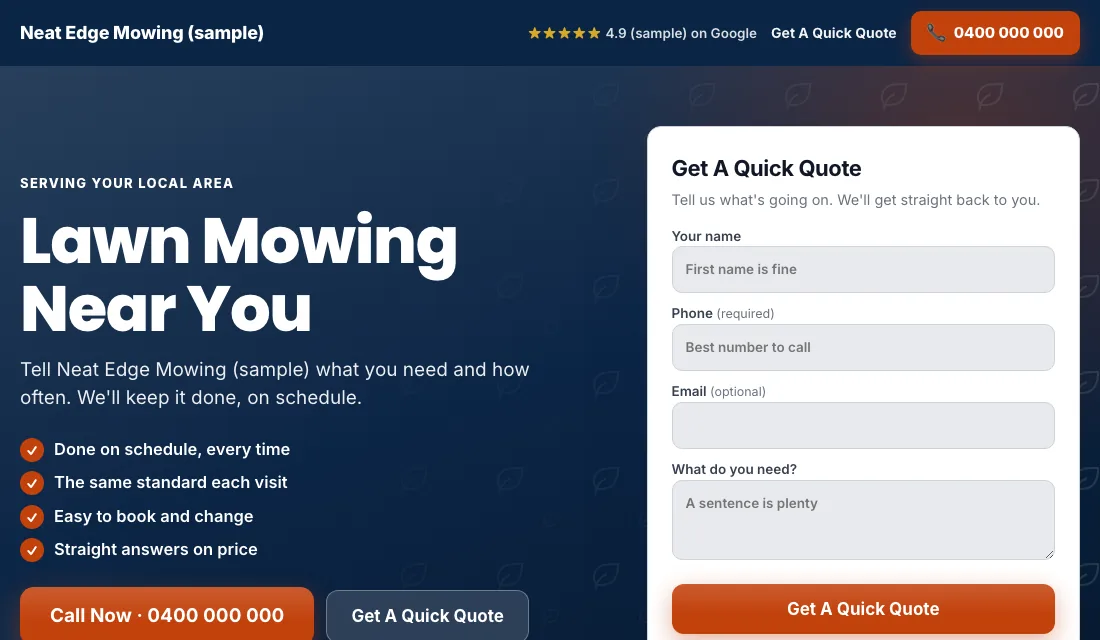
- A short quote form sits near the top: name, phone, address and what they need.
- Photos of lawns you have mowed, your crew and your equipment. A before and after of an overgrown yard works well.
- Reviews from real customers, near the top.
- A line about how often you come and what is included, such as edging and blowing off the driveway.
- No menu and no links that lead away. The only choices are call or send the form.
- It loads fast on a phone.
Google scores how closely your keyword, ad and page match. A closer match earns a better score, and a better score means you pay less for the same spot.
Budget and bidding when the job is small
Set the budget from your own numbers. Work out what a regular is worth to you over a season, not what one mow pays. Then decide what you can afford to pay for a lead and how many leads you need a month. Multiply the two. Plan to fund it for a couple of months, because the first weeks are uneven.
Bidding moves in stages as the account gathers data:
- Start on Maximize Conversions. Once tracking works, this is the setting to launch with. Google bids toward calls and forms. Leave it alone for two or three weeks before you judge it.
- If the account won't spend. A brand-new account sometimes has too little history to get moving. As a fallback, switch to Maximize Clicks with a cap on what you pay per click. Go back to Maximize Conversions as soon as leads are arriving.
- Set a target cost per lead. After about 30 conversions in 30 days, you can give Google a target, which it calls Target CPA. Set it 15 to 20 percent above what a lead has been costing. A target set too low makes Google stop showing your ad. Lower it a little each month while the leads keep coming.
Don't set bids by hand, and don't change budgets on a week of numbers. Look often, change rarely.
How to run Google Ads for lawn mowing through the season: a checklist
Every week:
- Check the search terms and block the mower shoppers, job seekers and DIY searches.
- Add searches that became regulars as exact match keywords.
- Mark each lead in your list: quoted, booked, regular or junk.
- Call back anyone you missed, the same day.
Every month:
- Compare cost per lead and cost per new regular for each ad group.
- Pause an ad group that spends and never books.
- Check which zip codes the leads came from. Drop the ones that are too far to be worth the drive.
- Make a test call and send a test form, in case tracking broke.
- Review the budget and the bidding stage.
Spring, summer and fall for a mowing business
Lawn mowing follows the grass, so your ads should too.
- Late winter and early spring: homeowners start looking for a mowing service before the first cut. Have the ads live a few weeks before growth starts, so you are there when they search.
- Spring: the busy sign-up window. This is when regulars are won, so put most of the budget here.
- Summer: steady. Overgrown yard cleanups come from people who fell behind or came back from vacation.
- Fall: mowing slows. Leaf cleanup and a last cut can run in their own ad group if you offer them.
- Late fall and winter: calls drop. Lower the budget or pause, and restart before spring.
If your route is full in a zip code, remove it from the campaign and spend the money where you still have room.
Or have software do all of this
That is how to run Google Ads for lawn mowing by hand: count every lead, keep the ads on your route, give each service its own ad group and page, block the mower shoppers each week, and step the bidding up as the data comes in. It works, and it takes an hour or so every week of the season.
If you would rather spend that hour mowing, Local Service Ads AI does these steps for you every morning, and it asks before it changes anything unless you tell it to go ahead. See Google Ads for lawn mowing.