Step zero in the US: get verified with Google
Google requires garage door businesses in the United States to pass its Advanced Verification before their ads can show. It is the same check locksmiths go through. You apply inside your own Google Ads account, and Google tells you what it needs.
Start this first. Everything else in this guide can be built while you wait, but nothing runs until it is done. If you advertise outside the US, check whether your country is on Google's list.
Count the calls before you pay for clicks
This is a phone trade. Most of your leads will be calls, so call tracking matters more here than a form does.
A conversion is the result you want from a click. Google bids toward it. If it can't see your calls, it guesses.
- In Google Ads, open Goals, then Conversions, and create a conversion action.
- Add calls from ads. This counts taps on the call button on the ad itself.
- Add calls from your website, so calls from the landing page count too.
- Set a minimum call length. A real "my door won't close" call lasts long enough to take an address. A parts inquiry ends in seconds.
- Add your quote form for new door requests.
- Mark these primary. Mark anything else secondary.
- Test with a real call and a form.
Then keep a lead list. Mark each call: was it a job you could quote, did you book it, what was it worth? A spring replacement and a call asking if you sell remotes over the counter look the same to Google. Once volume is steady, upload the booked ones so bidding learns from real jobs.
Account settings that stop waste
- Search only. Under Networks, untick Search Partners and the Display Network. You want the person typing "garage door repair near me" on Google Search.
- Presence in your service area. Under Locations, add the zip codes you will drive to. Under Location options, select "Presence: people in or regularly in your included locations". The default lets in people who are only interested in your area.
- Auto-apply off. Under Recommendations, open Auto-apply and turn off every box.
The schedule is worth a minute of thought. Urgent repairs can run longer hours than new-door quotes, but only run the hours someone answers. A stuck door at 6 p.m. is a booked job if you pick up and a wasted click if you don't.
Structuring campaigns by fault: springs, openers, doors
An ad group is a set of keywords sharing the same ads. Each fault is a different search and a different fix, so each gets its own ad group and page.
| Ad group | Example searches | Landing page |
|---|---|---|
| General repair | garage door repair near me, garage door won't open | Your repair page |
| Springs | garage door spring replacement, broken garage door spring | Your springs page |
| Openers | garage door opener repair, opener installation | Your opener page |
| Cables and tracks | garage door off track, garage door cable repair | Your off-track page |
| New doors | new garage door installation, garage door replacement | Your new door page |
Put new doors in their own campaign. That buyer is comparing styles and quotes over a week or two, while the repair buyer wants someone today. Different hours, different budget.
Leave out what you don't do. If you don't touch gates or commercial roll-up shutters, don't build for them.
Keywords: what someone with a stuck door types
A keyword is the phrase you give Google. A search term is what the person typed.
Ready-to-hire searches in this trade describe the fault or ask for the service:
- garage door repair near me
- garage door spring replacement
- garage door won't open
- garage door opener repair
- garage door off track
- emergency garage door repair
Add your city to a few of them.
Match types:
- Exact match shows your ad for that search or one that means the same.
- Phrase match shows it when the search contains your phrase's meaning with words around it.
- Broad match shows it for anything loosely related, which includes parts, remotes for sale and how-to videos. Leave it off.
Begin with phrase and exact. Each week, add the search terms that became booked calls as exact match keywords.
Searches a garage door company should block from day one
A negative keyword blocks a search. Add these at the account level before launch:
- DIY: how to, diy, video, diagram, manual, adjust.
- Parts and gear shoppers: parts, kit, for sale, used, second hand, home depot, lowes, amazon.
- Remote and keypad programming: program, reset, code, battery. These people want instructions, not a visit.
- Job seekers: jobs, hiring, salary, technician jobs, careers.
- Work you don't do: gates, shutters, commercial, if they are not yours.
- Competitors' and brand support searches: customer service, warranty, support number.
Add each as a phrase match negative, trimmed to its core word. "Parts" beats "garage door spring parts near me".
Spring replacement deserves a note. "How to replace a garage door spring" is a risky DIY search and never a call. The "how to" negative catches it.
Check search terms daily in the first two weeks, then weekly:
- Open the search terms report under Insights and reports.
- Sort by cost, highest first.
- Ask of each: is this person going to book a visit?
- If not, block the core word.
Writing ads for an urgent call
A responsive search ad holds up to 15 headlines and 4 descriptions.
- Name the fault: "Broken Spring Replacement", "Garage Door Won't Open?"
- Name the place: your city or "Near You".
- Promise only what you do: same-day service, stocked trucks, upfront pricing, a warranty on parts.
- End every description with the call: "Call now for same-day repair."
One ad per ad group, each about its own fault. After a few weeks, add a second and compare.
The extras, which Google calls assets, matter a great deal here:
- Call asset: the most important one. Many searchers will tap to call from the ad and never see your page.
- Sitelinks: at least four, such as "Spring Replacement", "Opener Repair", "New Doors" and "Reviews".
- Callouts: "Same-Day Service", "Licensed and Insured", "Upfront Pricing".
The landing page that gets the call
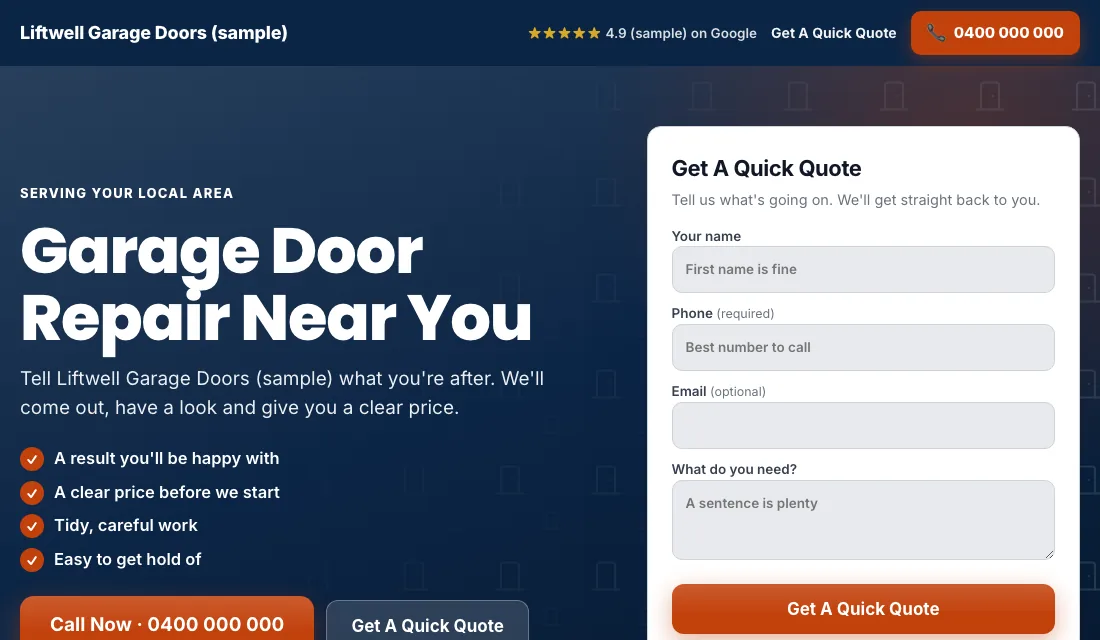
For visitors who do click through, each ad group needs its own page.
- The headline matches the fault they searched.
- The phone number is large, at the top, and dials when tapped. Repeat it down the page.
- A short form for people who can't call right now: name, phone, what the door is doing.
- Real photos of your trucks and technicians. People are letting a stranger into the garage, and they want to see who.
- Real reviews near the top.
- Your license and insurance details, where they apply.
- No menu and no links away.
- Fast on a phone, since nearly all of these searches happen standing in the driveway.
Google scores how well the keyword, ad and page match. A close match lowers the cost per click.
Budget and bidding for garage door repair
Set the monthly budget from leads needed times what you can pay per lead, and fund it for a couple of months.
- Start on Maximize Conversions. With calls counted, Google bids toward calls. Leave it two or three weeks.
- If the account won't spend. New accounts sometimes stall. Use Maximize Clicks with a cap on the bid per click, then switch back once calls arrive.
- Target cost per lead. After about 30 conversions in 30 days, set a Target CPA 15 to 20 percent above your recent cost per lead. Too low and Google stops spending. Lower it slowly, month by month, while calls keep coming.
No manual bidding, and no changes on a week of data.
Week by week: how to run Google Ads for garage door repair once it is live
Weekly:
- Check search terms and block the DIY and parts searches.
- Add searches that became jobs as exact match keywords.
- Mark every call: booked, quoted or junk.
- Look at missed calls. In this trade a missed call is a lost job, so fix the gaps in who answers.
Monthly:
- Compare cost per lead and cost per booked job for springs, openers, repairs and new doors.
- Pause an ad group that spends and doesn't book.
- Call your own ad to test tracking.
- Check the phone number on every page.
- Review bidding stage and budget.
Seasons and timing for garage door repair
- Cold snaps: springs are more likely to break in the cold, and openers struggle with stiff doors. Have the springs ad group funded before winter.
- Storm and high-wind weeks: dented panels and doors off their tracks.
- Spring and summer: new doors and opener upgrades, as people work on the house.
- Early morning and early evening: when people leave for work or come home and find the door won't move. If you can answer the phone from early until late, your ads should run then.
Or have software do all of this
That is how to run Google Ads for garage door repair by hand: get verified, count every call, lock the settings, one fault per ad group, block DIY and parts searches, and move bidding up as the data grows. It needs attention each week.
If you would sooner be fixing doors, Local Service Ads AI does these checks every morning and asks you about every change, unless you tell it to go ahead. Verification with Google stays yours to do. See Google Ads for garage door repair.