Before you spend: track walk-throughs and contracts
A commercial client is a business, the clean repeats every week, and the decision goes through a walk-through and a quote. One signed contract can be worth years of work. So you need to see every lead and follow it to the end.
A conversion is the action you want after a click. For a contract cleaner that is a phone call or a request for a quote.
- In Google Ads, open Goals, then Conversions, and create a new conversion action.
- Add one for calls from your ads and one for calls from your website. Set a minimum call length. People looking for a night shift will ring this number too.
- Add one for your quote request form, counted when it is sent.
- Mark those primary, which means bidding uses them. Mark everything else secondary.
- Make a test call and send a test form. Check both show in Google Ads within a day.
Then keep a lead list with these columns: real business inquiry or not, walk-through done, quote sent, contract signed, and monthly value. A medical office asking for a five-night contract and a person asking for cleaning work are both "one call" to Google. Once you have enough signed contracts, upload the quoted and signed leads so bidding learns what a real client looks like.
Account settings that stop waste
Set these three before you write an ad.
- Search only. In campaign settings, open Networks. Untick Search Partners and untick the Display Network. You want your ad on Google Search for "office cleaning services near me".
- People in your area. Open Locations and add the cities or zip codes where you take contracts. In Location options, choose "Presence: people in or regularly in your included locations". The default also reaches people only interested in your area.
- Auto-apply off. Open Recommendations, find Auto-apply, and turn every box off. Otherwise Google can add loose "cleaning" keywords that bring homeowners and job seekers.
Then set the ad schedule. This one is different from most trades. You clean at night, but managers search at their desks. Run ads on weekdays in business hours, and make sure someone answers the phone then.
For the area, think in routes. A new site near your existing ones is worth more than one across town, because the same crew can cover both in a night.
How to run Google Ads for commercial cleaning with one kind of site per ad group
An ad group is a set of keywords that share the same ads. A practice manager and a gym owner have different worries, so each kind of site gets its own ad group and landing page.
| Ad group | Example searches | Landing page |
|---|---|---|
| Office cleaning | office cleaning services, office cleaners near me | Your office page |
| Janitorial services | janitorial services near me, janitorial company | Your janitorial page |
| Medical office cleaning | medical office cleaning, dental office cleaning service | Your medical page |
| Daycare and school cleaning | daycare cleaning services, school cleaning company | Your daycare page |
| Gym cleaning | gym cleaning services, fitness center cleaning | Your gym page |
| Apartment common areas | apartment building cleaning, common area cleaning service | Your building page |
Only build ad groups for sites you want. If you don't do warehouses, restaurants or one-time post-construction cleans, leave them out and block them.
Keep homes out of this campaign entirely. House cleaning is a different trade with different searches.
Keywords: what a manager ready to hire types
A keyword is the phrase you give Google. A search term is what the person typed. You pay for the search term.
Ready-to-hire searches name the kind of site and a word that means a company:
- commercial cleaning company near me
- office cleaning services
- janitorial services in your city
- medical office cleaning company
- commercial cleaning quote
The words services, company, contractors, quote and near me are the sign of a buyer. The plain word "cleaning" or "cleaner" is not specific enough to use alone.
Match types set how loosely Google matches:
- Exact match shows your ad for that search or one with the same meaning.
- Phrase match shows your ad when the search includes the meaning of your phrase, with other words around it.
- Broad match shows your ad for anything Google finds related: house cleaners, cleaning jobs, cleaning supplies. Leave it alone.
Start with phrase and exact. When a search term leads to a walk-through, add it as an exact match keyword in the right ad group.
Searches to block from day one
A negative keyword is a search you block. Plenty of "commercial cleaning" searches come from people who want work, not a cleaner. Add these at the account level before the first click:
- Job seekers: jobs, job, hiring, careers, salary, pay, night shift, part time, employment.
- Homes: house, home, maid, residential, apartment cleaning for tenants, move out, move in, airbnb.
- Buying a business: franchise, for sale, business for sale, contracts for sale, buy accounts.
- Starting a business: how to start, business plan, how to bid, how to get contracts, bid template.
- Doing it in-house: checklist, template, schedule template, how to.
- Suppliers: supplies, products, equipment, chemicals, wholesale, machines.
- Students: course, training, certification.
- Other kinds of cleaning: carpet only, window, pressure washing, dry cleaning, unless you offer them.
Take care with "apartment". If you clean apartment common areas for building managers, don't block the word. Block "apartment move out" and similar instead.
Add each as a phrase match negative, trimmed to the core word. Block "franchise", not "commercial cleaning franchise opportunities".
Then check the search terms. Every day or two for the first two weeks, then weekly:
- Open the search terms report under Insights and reports.
- Sort by cost, highest first.
- Ask: is that a manager who could sign a contract?
- If not, block the core word.
Writing ads a manager will act on
A responsive search ad takes up to 15 headlines and 4 descriptions, which Google mixes. Fill in as many as you can.
- Say the service in business words: "Office Cleaning Contracts", "Medical Office Cleaning", "Janitorial Services".
- Say the area: your city or county.
- Say what a manager worries about: insured and bonded, background-checked staff, the same crew each night, a supervisor who inspects, a contact who answers. Only what is true.
- Offer the next step they expect: "Free Walk-Through and Quote".
A manager's real fear is the cleaner who stops showing up. Speak to reliability more than to price.
Add the extras, which Google calls assets:
- Call asset: your number on the ad.
- Sitelinks: at least four, such as "Office Cleaning", "Medical Offices", "Request a Walk-Through" and "About Our Crews".
- Callouts: short phrases such as "Insured and Bonded", "Background-Checked Staff" or "After-Hours Service".
The landing page: a page a manager can say yes to
Build one page per ad group. Someone who searched "medical office cleaning" should land on a page about medical offices, not your home page.
- The headline matches the search and names the kind of site.
- The phone number is at the top and starts a call when tapped.
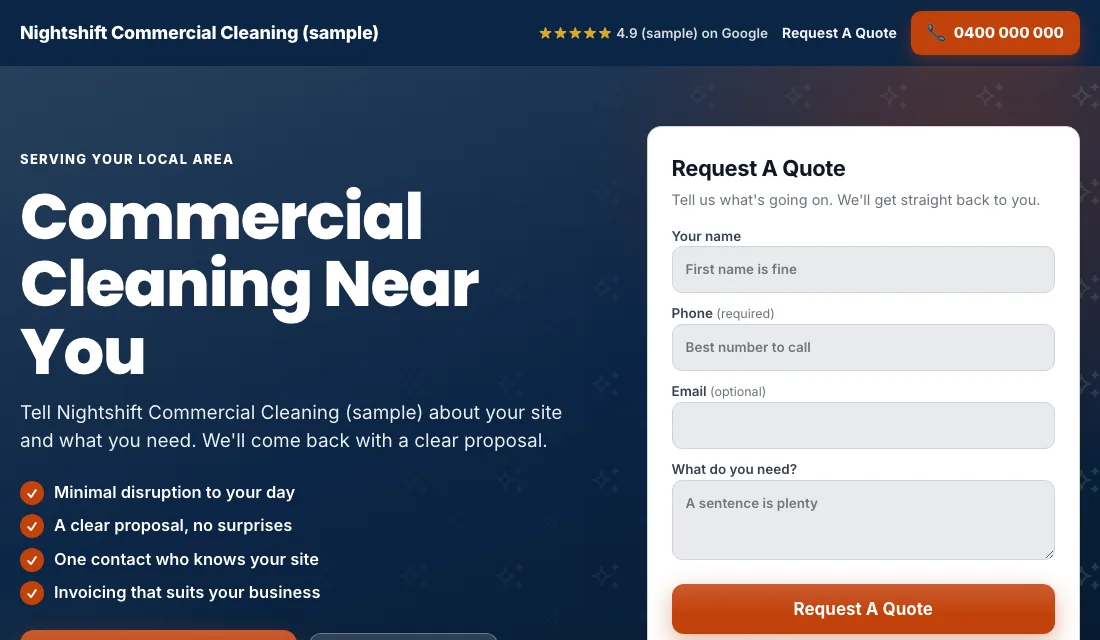
- A quote request form shows near the top: name, business name, phone, email, the kind of site, rough size, and how many cleans a week. Asking for the business name alone puts off most job seekers.
- What you do for that kind of site. A medical page talks about exam rooms and waiting areas. A daycare page talks about toys, floors and nap rooms.
- Proof: reviews from business clients, the kinds of sites you already clean, your insurance.
- How it works: walk-through, written quote, start date, a named contact.
- No menu and no careers link.
- It reads well on a desktop screen and on a phone. Managers often search from a work computer.
Google scores how well keyword, ad and page match. A closer match earns a higher score, and a higher score means a lower price for the same spot.
Budget and bidding when one contract is worth a lot
Start from your own numbers. How many new contracts do you want each quarter? How many quotes does it take to sign one, and how many leads to reach a quote? That gives you leads per month. Multiply by what you can afford per lead, given that a contract pays every month. Fund the plan for a few months, because the sale is slow.
- Conversions from the start. With tracking working, start on Maximize Conversions, so Google bids toward calls and forms. Give it three weeks before judging.
- If a new account won't spend. A new account may stall. Switch to Maximize Clicks with a cap on the bid per click, then return to Maximize Conversions once leads arrive.
- A target cost per lead. After about 30 conversions in 30 days, you can set a target cost per lead, which Google calls Target CPA, 15 to 20 percent above what leads have cost. Lower it a little each month while leads hold.
Many contract cleaners won't reach 30 conversions in a month. Stay on Maximize Conversions in that case. Never bid by hand, and don't change bids or budgets on a week of data.
Your weekly and monthly checklist
Every week:
- Check the search terms. Block job seekers and home searches first.
- Add searches that led to a walk-through as exact match keywords.
- Update every open lead: walk-through, quote sent, signed, lost.
- Call new leads within the hour, in business hours. Managers shortlist quickly.
Every month:
- Look at cost per lead and cost per quote for each ad group. Look at cost per signed contract over the last quarter.
- Pause an ad group that spends and never reaches a walk-through.
- Make a test call and send a test form to confirm tracking works.
- Check each page still names the right services and areas.
- Review the budget against how many new sites your crews can take.
Seasons and timing for commercial cleaning
Contract cleaning is steady, but managers shop around at certain times.
- New year: new budgets and a fresh look at suppliers. A strong time for quotes.
- End of a financial year or quarter: contracts come up for renewal and managers compare prices.
- Late summer: schools and daycares prepare for the new term.
- Cold and flu season: more interest in disinfection and more frequent cleans, most of all from medical offices and daycares.
- Any time a cleaner lets someone down: a common trigger, and it has no season. This is why the ads should run all year.
Within the week, expect inquiries Monday to Thursday in office hours. Weekends are quiet, so there is little reason to run ads then.
Or have software do all of this
That is how to run Google Ads for commercial cleaning by hand: track every lead through to a signed contract, lock the settings, keep each kind of site in its own ad group with its own page, block job seekers and homeowners every week, and let the bidding step up as data arrives. It works, and it takes steady attention.
If you'd rather spend that time on your clients and crews, Local Service Ads AI does these steps for you every day. Nothing changes without your OK unless you tell it to go ahead. See Google Ads for commercial cleaning.